
Enterprise AI
The Inference Paradox:
AI Gets Cheaper.
Your Bill Gets 5× Bigger.
Model prices are falling. Token economics keep improving. Open models are cheaper, inference infrastructure is more efficient and every generation promises better value per unit of intelligence. Yet the enterprise cost of AI is moving in the opposite direction. As products evolve from chat features into multistep agents, the number of model calls, tools, retries, checks and context windows inside each “task” can explode. That is the inference paradox: better unit economics can still produce a more expensive system.
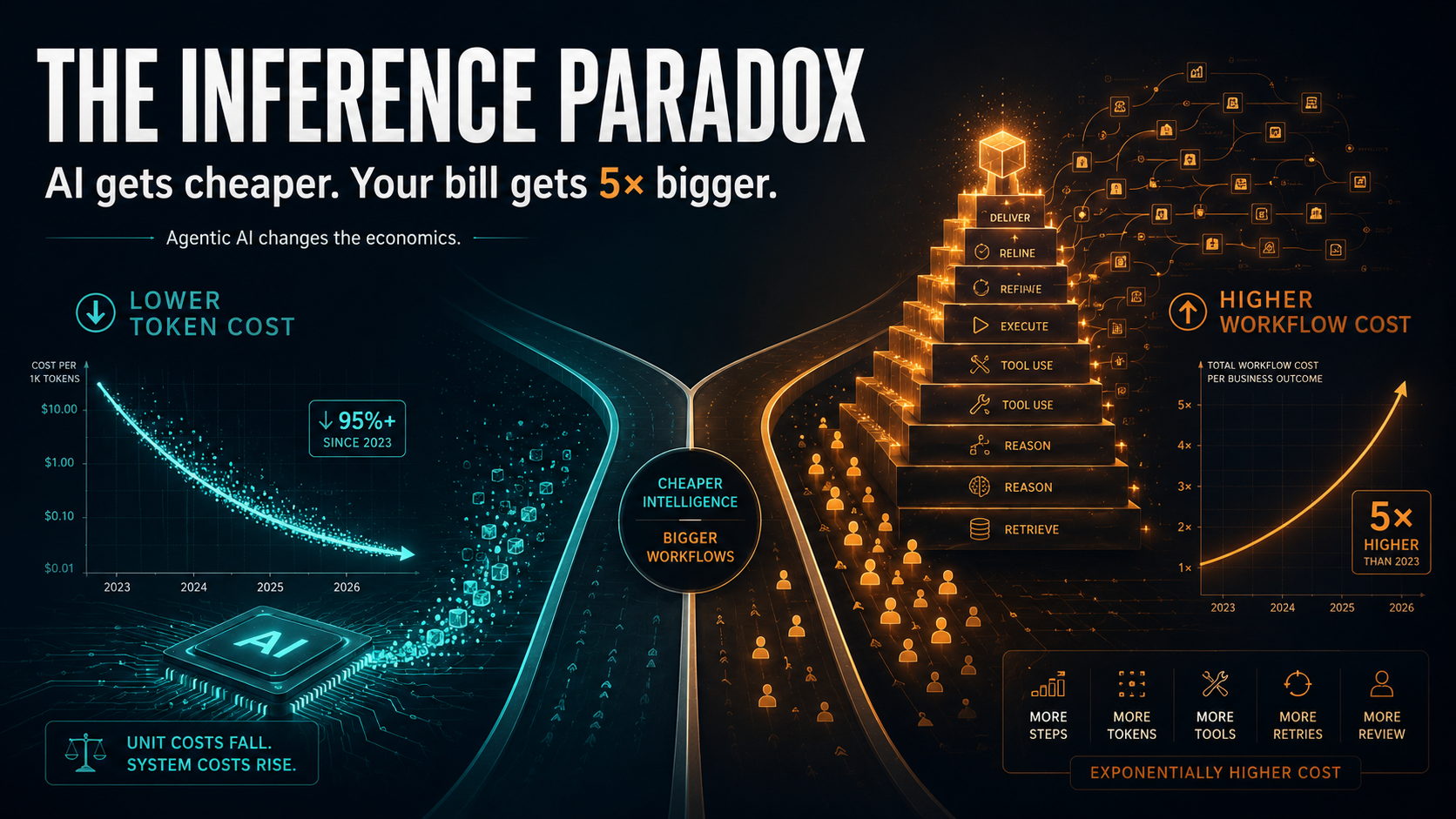
Enterprise AI budgeting is entering a phase that looks deceptively familiar. Cloud teams have seen this movie before. Unit prices fall, executives assume the system becomes cheaper, adoption accelerates, and then the total bill rises faster than expected because the workload itself changes. Generative AI is now doing the same thing at higher speed. Cheaper tokens are not reducing the enterprise AI bill. In many cases, they are making larger bills possible.
Gartner formalised this problem in August 2026, warning that AI inference costs per agentic workflow will increase more than fivefold through 2028. The reason is not that model providers failed to lower prices. Gartner’s point is the opposite: better unit economics are subsidising more complex workflows — and those workflows consume far more intelligence than a simple chatbot prompt-response exchange.
This is why the wrong question for the next two years is “what is the cost per token?” The right question is “what is the cost per completed outcome?” An agent that plans, searches, calls tools, evaluates evidence, retries failures, cross-checks itself and writes into business systems may produce far more value than a chatbot. But it can also generate a cost structure that looks nothing like the prompt budgets organisations became used to in 2024.
The Price of Intelligence Is Falling. The Cost of Using It Well Is Not.
The Inference Paradox — Two Curves Moving in Opposite Directions
Stanford documented a 280× drop in the cost of GPT‑3.5-level capability between November 2022 and October 2024. Demirer, Fradkin and Tadelis show the broader market price of intelligence falling by roughly 1,000×.
As reasoning chains deepen and more steps invoke models, tools and checks, the cost per completed job rises even while each individual call is cheaper.
These are conceptually different curves. The left side shows falling unit prices; the right side shows increasing workflow cost. Gartner’s fivefold forecast refers to the right side.
That distinction matters because many AI cost dashboards are still built around the wrong layer of analysis. They show price per request, price per token or average spend by model. Those metrics are useful, but they do not tell finance or product leaders what a customer-support workflow, a coding agent, an automated claims review or a contract-extraction process truly costs when the full system is counted end to end.
Cheap intelligence does not mean cheap AI. It often means organisations can now afford to build workflows that were previously uneconomic — and those workflows consume far more intelligence than the ones they replace.
Straithead AnalysisAgentic AI Is Not a Slightly Larger Chatbot. It Is a Cost Multiplier.
A basic assistant reads a prompt and returns an answer. A useful agent behaves differently. It decomposes a goal, fetches context, queries one or more models, decides which tools to call, executes them, interprets the results, checks whether the result is good enough, retries if it is not, and sometimes keeps monitoring the environment after the original task seems complete.
Where the Extra Cost Comes From
This is why Gartner says product leaders cannot rely on efficient token economics alone to rationalise AI cost. Each successive generation of capability encourages the use of more sophisticated models, deeper workflows and more expensive intelligence — even if the underlying price-per-token headline keeps improving.
The Real Enemy Is Not Price. It Is Elasticity.
Economists have seen versions of this dynamic before. When a resource becomes more efficient, consumption can rise rather than fall because more use cases become affordable. Generative AI now has a clear enterprise version of that story. Lower token prices are not merely lowering the cost of today’s workflows. They are unlocking entirely new workflows that would never have been built at older prices.
That is why a spreadsheet that proves model prices fell by 40 percent can coexist with a finance review showing the AI bill rose by 150 percent. These are not contradictory data points. They are different views of the same system.
The visible model bill is often only one layer of the total system. The real cost stack also includes retrieval, vector databases, orchestration middleware, external APIs, sandbox execution, observability, testing, human-in-the-loop review and downstream cloud infrastructure. When AI becomes embedded in workflows, the supporting layers matter almost as much as the model itself.
AI FinOps Must Measure Cost Per Outcome, Not Cost Per Token.
If cloud FinOps taught organisations to think in unit economics for compute and storage, AI FinOps has to go a step further. It must measure cost per useful outcome. A cheap model that fails twice, triggers retries, pulls excessive context and escalates to a human may be more expensive than a premium model that succeeds once.
| Cost layer | Why it rises in agentic workflows | What to monitor |
|---|---|---|
| Model inference | More steps, longer contexts, harder reasoning | Tokens per completed task |
| Tool usage | Agents browse, call APIs, search and write to systems | Tool calls per task |
| Retrieval & memory | Better outcomes require more enterprise context | Documents fetched / memory growth |
| Validation & guardrails | Production reliability adds testing and checks | Retries, review rates, exceptions |
| Human oversight | Escalations and audits persist in high-risk use cases | Cost per accepted result |
The most useful AI cost dashboard may therefore look less like an API billing page and more like a margin stack: revenue or value created, task success rate, model cost, orchestration cost, human review cost, and cost per successful outcome by workflow. Without that structure, enterprises risk scaling volume before they understand economics.
This article sits directly beside two earlier Straithead arguments: that the market price of intelligence is collapsing, and that physical AI infrastructure still matters even when models become cheaper. For the first, read The 1,000× Collapse →. For the second, read The Memory Supercycle →.
Six Moves for the AI Cost Era You Are Actually Entering
Measure full-task token use, retries, tool calls, latency, review rates and success outcomes across the whole chain.
Use cheaper models for classification, retrieval and low-risk steps; reserve premium reasoning models for the minority of steps that genuinely need them.
Limit the number of tools, iterations, self-reflection loops and delegated subtasks an agent can trigger by default.
A cheaper output that fails business review is not a saving. Build unit economics around accepted or completed work.
Agents may look impressive in pilots while hiding expensive retry loops and oversized contexts that become painful at scale.
Product, engineering, finance and security all influence the cost structure. None of them can manage it alone.
There is another strategic implication here. As AI systems shift from answer generation to business execution, the budget debate moves closer to classical enterprise-software questions: margins, utilisation, routing, service levels, governance and capital discipline. The winning organisations may not be the ones with the flashiest demos. They may be the ones best able to control the economics of routine intelligence at scale.
The Assessment
For two years, the AI market trained enterprises to celebrate falling model prices as though they automatically translated into cheaper AI. That was always only half true. Lower unit prices are real, important and strategically meaningful. But they are not the same thing as lower system cost.
Agentic workflows are changing what organisations buy when they buy intelligence. They are no longer purchasing a single answer. They are purchasing a sequence of reasoning, memory, retrieval, verification, execution and oversight — and every additional step has an economic signature.
The real risk is not that model providers fail to reduce prices. It is that enterprises interpret those falling prices as evidence that AI economics are solved.
They are not solved. They are moving up a level. The next phase of advantage will go to organisations that understand the full workflow cost, route intelligence intelligently, and measure AI the way serious operators measure everything else: by outcome, margin and control.
The token got cheaper.
The workflow got hungrier.
Sources & References
- Gartner — “Gartner Predicts AI Inference Costs Per Agentic Workflow Will Increase More Than Fivefold Through 2028,” August 17, 2026.
- Stanford Institute for Human-Centered AI — AI Index Report 2025, model efficiency and inference-cost analysis.
- Demirer, Fradkin & Tadelis — “The Emerging Market for Intelligence: How Firms Buy and Sell AI,” Journal of Economic Perspectives, Summer 2026.
- OpenAI API pricing documentation, accessed August 2026.
- Straithead — The 1,000× Collapse: AI Intelligence Is Becoming a Commodity
- Straithead — The Memory Supercycle: How AI Is Repricing Enterprise IT
¡Excelente artículo! Para texto a imagen con Swift-image prueba Swift-image: /. Swift-image
Clair et pratique. Essayez Gem Transcribe : . Gem Transcribe
Appreciate the depth in this piece. For first/last-frame and reference video, see MiniMax H3 Video Generator at /. MiniMax H3 Video Generator