
Artificial intelligence is often framed as a technology story, but for most enterprises it is really a business transformation story. The important question is not just whether a company is using AI, but how deeply AI is changing the organization. A useful way to understand that change is through three layers: outcome change, process change, and identity change. This framework helps explain why some companies get modest gains from AI while others use it to redesign operations and reposition the business itself.
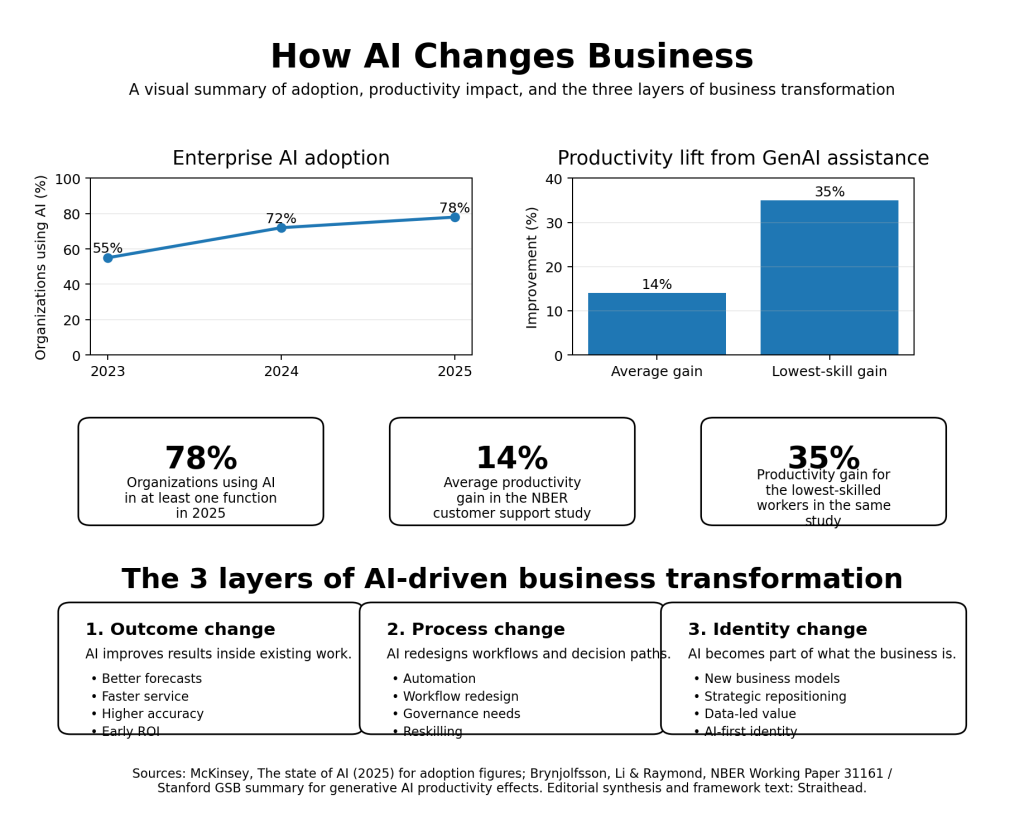
Enterprise AI adoption is rising quickly, and productivity studies already show measurable gains. Over time, those gains can evolve from outcome improvements into process redesign and ultimately identity change.
Outcome change: AI improves results inside existing work
The first layer of AI transformation is outcome change. At this stage, the business still works in roughly the same way, but results improve. Teams produce faster responses, more accurate forecasts, better recommendations, or fewer errors. McKinsey reports that 78% of organizations now use AI in at least one business function, up from 72% in early 2024 and 55% a year earlier, showing how quickly AI has moved into mainstream enterprise activity.
A well-known example comes from customer support. In the NBER study Generative AI at Work, researchers found that workers using generative AI assistance saw an average productivity increase of about 14%, while the least-skilled workers improved by roughly 35%. That is a strong example of outcome change: performance improves before the business fully redesigns the workflow.
For business leaders, this is usually the easiest stage to justify because the value is visible and measurable. AI can improve outcomes in marketing, IT support, operations, finance, and service functions without immediately forcing large structural change.
Process change: AI redesigns how work gets done
The second layer is process change. This happens when AI stops being just a helpful tool and starts reshaping workflows, handoffs, approvals, and decision paths. At this stage, the business is no longer asking, “How do we use AI inside the existing process?” It starts asking, “Should the process itself be redesigned around what AI can now do?”
This matters because many organizations scale AI unevenly. Recent MIT Sloan Management Review reporting found that although enterprise AI deployment is spreading quickly, 84% of organizations had not redesigned jobs and only 21% had mature oversight for autonomous systems. That gap is important: companies may adopt AI widely but still fail to redesign work, governance, and accountability around it.
Process change shows up in areas like automated underwriting, predictive maintenance, AI-assisted supply chain planning, software engineering copilots, and intelligent service routing. In each case, AI changes not just the output but the operating model: who decides, when they decide, what gets automated, and what humans supervise. MIT Sloan’s work on scaling AI also stresses that value comes from redesigning work and deployment practices, not just adding AI on top of old structures.
For business leaders, this is often the hardest stage because it requires decisions about process ownership, risk controls, human oversight, and reskilling. Outcome change can be piloted by one team; process change usually demands cross-functional redesign.
Identity change: AI changes what the business is
The deepest layer is identity change. This is where AI stops being a capability and starts becoming part of the company’s strategic identity. The organization begins to redefine itself around data, intelligence, automation, and digital decision systems. Instead of saying, “We use AI,” the company increasingly behaves like an AI-enabled business by default.
Deloitte’s State of AI in the Enterprise describes this broader shift as AI moving from pilot programs toward enterprise scaling, with AI access and impact spreading across the organization. That is significant because scaling AI changes executive questions. Leadership stops asking only about isolated use cases and starts asking whether AI should shape the company’s value proposition, operating model, and market position.
Identity change is visible when retailers become recommendation businesses, financial institutions become intelligence-led platforms, industrial firms reposition as software-and-analytics companies, or service organizations build their competitive edge around decision quality and automation. This is not just digital transformation with new branding; it is strategic repositioning driven by what AI makes possible.
Why this framework matters
The reason this framework is useful is that it prevents a shallow understanding of AI transformation. If leaders look only for immediate productivity improvements, they may miss the larger changes unfolding underneath. Outcome change explains early wins. Process change explains operational redesign. Identity change explains strategic reinvention. Together, these three layers provide a more complete business lens for analyzing AI adoption.
For CIOs, enterprise architects, transformation leaders, and line-of-business managers, the practical question is straightforward: Which layer are we actually in? If AI is improving outputs but workflows are unchanged, the organization is still in the first layer. If workflows are being redesigned, it has entered the second. If strategy and positioning are shifting, it has entered the third.
Final takeaway
Artificial intelligence does not change every business in the same way. In some organizations it produces better outcomes. In others it redesigns processes. In the most ambitious cases, it changes the organization’s identity. Business leaders who understand these three layers are better equipped to evaluate where AI is creating value now, where it requires redesign, and where it may eventually redefine the enterprise itself.
“The biggest mistake in AI strategy is to treat AI as only a tool. In reality, AI changes outcomes first, processes next, and eventually the identity of the business itself.”
Sources and credits
This article draws on reporting and research from: