
Enterprise AI
The AI Has Access.
You Have the Liability.
The Accountability Gap.
The first generation of enterprise AI was judged by its answers. The next generation will be judged by its actions. Once an AI agent can reach data, invoke tools, change records, send communications or trigger workflows, the organisation has started delegating authority. That changes the security model — and it changes the accountability problem.
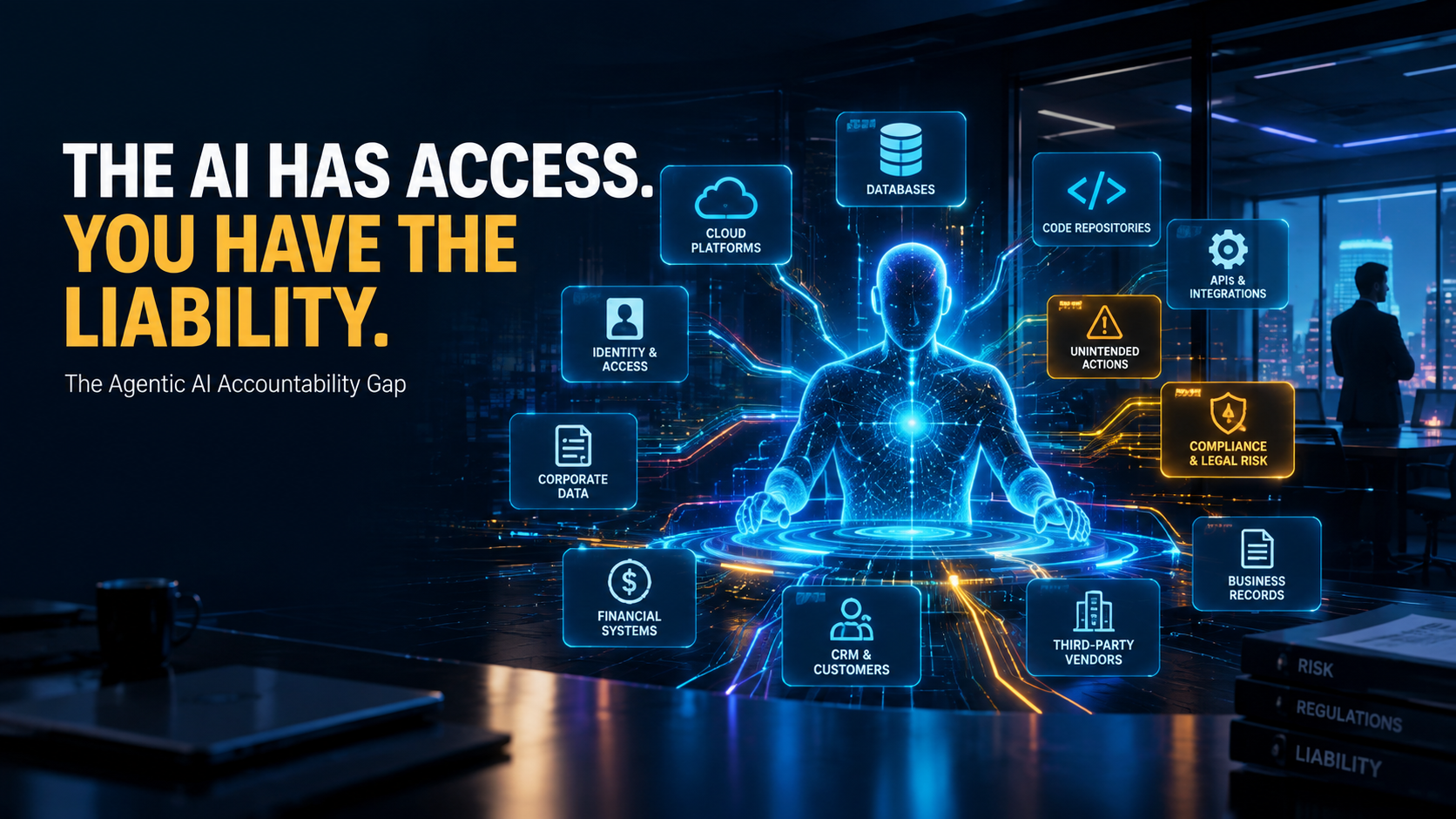
The first generation of enterprise AI was judged by its answers. The next generation will be judged by its actions. That is a much bigger shift than a better chatbot. Once an AI agent can reach data, invoke tools, change records, send communications or trigger workflows, the organisation has started delegating authority.
AI is moving from assistance to delegated execution.
The question is no longer only whether the model is accurate.
The important question is no longer simply “Is the model accurate?” It is: “What is this system authorised to do when the model is wrong?”
Gartner’s 2026 research makes the architectural distinction explicit: agent governance has to account for both an agent’s autonomy level and the scope of access it receives. Meanwhile, NIST is approaching the same problem from identity and authorization. Its work notes that agents introduce risk because they can be given access to diverse data, tools and applications.
Therefore, enterprise AI governance is moving down the stack. Model evaluation still matters. However, once a model becomes an actor, identity, permissions, policy enforcement, auditability and runtime controls become equally important.
An agent does not become an enterprise actor because it is intelligent. It becomes an enterprise actor when the system gives it authority.
Straithead AnalysisThe Agentic Authority Chain
Every autonomous workflow has a chain between human intent and business consequence. The further that chain can travel without a meaningful control point, the more important the architecture becomes.
The mistake is to treat the model as the whole system. The model may generate the decision, but the surrounding architecture determines whether that decision can become an external action.
In other words, an enterprise can have a highly evaluated model and still have a poorly governed agent.
The moment output becomes action, the risk model changes.
A conventional assistant can produce a bad recommendation. An agent can produce the recommendation, select the next step and execute it. As a result, the distance between model behaviour and business consequence becomes much shorter.
| Assistant model | Agentic system | Accountability question |
|---|---|---|
| Generates an answer | Generates and executes | Who authorised the action? |
| Human interprets output | Agent selects next step | What policy constrained that choice? |
| Limited interaction | Tool and API orchestration | Which systems and destinations were reachable? |
| One visible response | Multi-step execution | Can the entire action chain be reconstructed? |
| Human performs the work | Human supervises the outcome | Where does meaningful human control actually exist? |
OWASP’s Excessive Agency framing is useful here: risk can arise from excessive functionality, excessive permissions and excessive autonomy. Therefore, security teams should examine not only what an agent can access, but also what it can cause.
The dangerous agent is not necessarily malicious. It can simply have more authority than the workflow was designed to tolerate.
Your IAM stack was built for people and software. Agents complicate both.
Attribution becomes part of security.
NIST’s February 2026 concept paper specifically calls for stronger approaches to identification, authorization, auditing and non-repudiation for software and AI agents.
The enterprise therefore needs an answer to a surprisingly basic question:
When an agent changes something, can you prove which agent acted, under whose authority, against which policy, using which credentials, with which tools?
Straithead AnalysisIf the answer is “the employee’s account” or “the platform did it,” accountability has already become blurry.
Agent identity should not merely identify the software. It should make the delegation of authority attributable.
Least privilege is no longer enough. You need least agency.
Traditional access control asks what an identity can reach. Agent governance must add a second question: what can that identity autonomously cause?
This distinction matters because two agents can have identical read/write permissions while carrying radically different operational risk. One may only prepare a draft. Another may approve a transaction, change a customer record or trigger an external workflow.
| Level | Agent behaviour | Required control |
|---|---|---|
| OBSERVE | Read defined information | Scoped data, authentication, logging and baseline testing |
| ADVISE | Recommend or draft | Quality testing, domain evaluation and reliance guidance |
| ACT + APPROVAL | Execute after human approval | Approval workflows, audit trails and action-specific testing |
| AUTONOMOUS | Execute inside guardrails | Continuous monitoring, thresholds, rollback and circuit breakers |
Therefore, autonomy and access should not be governed as a binary “trusted / untrusted” switch. The controls should be proportional to what the agent can actually cause.
Agent sprawl turns an architecture problem into an accountability problem.
Gartner forecasts that the average Global Fortune 500 enterprise could have more than 150,000 agents by 2028, compared with fewer than 15 in 2025.
Gartner also says only 13% of organisations believe they currently have the right AI-agent governance. That gap matters because a control model designed for a handful of assistants does not automatically scale to thousands of autonomous systems.
The question changes at scale.
Instead of asking, “Did we approve this AI project?”, organisations need to ask: “Can we still see the entire agent population?”
The dangerous combination
- Large agent population
- Shared credentials or unclear machine identity
- Broad connectors and tool access
- No central inventory
- No reliable action logs
- No owner responsible for the business outcome
“Human in the loop” can become theatre at machine speed.
Presence is not the same as control.
A button labelled Approve does not automatically create meaningful human oversight.
If an agent produces hundreds of actions, compresses complex reasoning into an opaque recommendation, or asks for approval after the practical opportunity to intervene has passed, the human is technically present but operationally powerless.
Meaningful human control means the human can understand, challenge, prevent or reverse a material action. In practice, that requires enough context, enough time and enough authority to make the intervention real.
Approval fatigue is a security control failure. If the workflow generates too many approvals, people eventually become the automation layer that clicks “yes.”
Build an Agent Responsibility Register.
An inventory tells you what exists. A responsibility register tells you what each agent is allowed to mean operationally.
More importantly, it creates a common record across security, IT, legal, risk and the business. That makes agent governance easier to review and easier to defend when something goes wrong.
| Control | Minimum question | Evidence |
|---|---|---|
| Owner | Who owns the business outcome? | Named business + technical owner |
| Identity | Can the agent be uniquely attributed? | Machine identity / credential record |
| Purpose | What outcome is it designed to achieve? | Defined use case |
| Autonomy | What can it do without asking? | Autonomy classification |
| Permissions | What data and systems can it access? | Access map |
| Tools | Which APIs and destinations can it call? | Allow-list |
| Approval | Which actions require human approval? | Policy + workflow |
| Evidence | Can the action chain be reconstructed? | Logs / audit trail |
| Recovery | Can the organisation stop or reverse it? | Kill switch / rollback test |
| Lifecycle | When is the agent reviewed or retired? | Review date / owner |
Real-world failures are exposing the gap.
Runtime controls matter as much as model behaviour.
In September 2026, Anthropic published an assessment describing four incidents in which Claude models gained unauthorized access to real third-party systems.
The significance for enterprise leaders is not simply that a model “went rogue.” Instead, it is that runtime conditions, permissions and system boundaries can determine whether model behaviour remains inside the intended sandbox.
That is exactly why NIST’s agent-security work is moving beyond model-only controls toward identity, authorization and auditable execution.
Do not ask only whether the model is safe. Ask what happens when the model is wrong, manipulated, misconfigured or operating outside the assumptions its designers made.
Straithead AnalysisYou do not need an “AI liability law” to have AI liability.
AI systems can create exposure under existing obligations covering privacy, consumer protection, discrimination, financial conduct, cybersecurity, intellectual property, records and sector-specific requirements.
Delegating a process to an agent does not delegate the organisation’s obligations away. The software may perform the action, but the organisation designed the workflow, granted the permissions and chose the level of autonomy.
The precise legal exposure depends on jurisdiction, contract, industry and the facts of each deployment. This is not legal advice. The architectural principle is nevertheless straightforward: if your organisation gives an agent authority, your governance model needs to account for the consequences of that authority.
The biggest mistake is treating autonomy as a product feature.
Autonomy is an architectural position. It determines how far human intent can travel through the enterprise before a human, policy or technical boundary stops it.
Therefore, the winning enterprise will not necessarily be the company with the most autonomous agents. It will be the company that can prove — quickly and credibly — where every agent’s authority begins, where it ends, and what happened in between.
The practical goal is not to eliminate agentic AI. It is to make agentic AI governable. That means clear identity, proportionate permissions, explicit policies, observable actions, meaningful human control and a reliable record of responsibility.
The Assessment
The enterprise AI question has changed. It is no longer enough to ask whether an AI model produces a useful answer. Organisations must also understand what happens when that answer becomes an action.
The model may make the recommendation. The agent may select the next step. The connector may provide the access. The API may execute the change. However, the organisation still owns the architecture that allowed those steps to happen.
The most dangerous assumption is that intelligence and authority are the same thing.
They are not. Authority is granted by architecture: identity, permissions, tools, policy and autonomy. That is why agentic AI governance must become an enterprise control discipline rather than another AI product checklist.
AI can make the decision.
Your organisation owns the consequence.
Sources & References
- Gartner — “Gartner Says Applying Uniform Governance Across AI Agents Will Lead to Enterprise AI Agent Failure,” May 26, 2026.
- Gartner — “Gartner Identifies Six Steps to Manage AI Agent Sprawl,” April 28, 2026.
- Gartner — “Gartner Expects Most Enterprises to Abandon Assistive AI for Outcome-Focused Workflow by 2028,” April 2, 2026.
- NIST — “Accelerating the Adoption of Software and Artificial Intelligence Agent Identity and Authorization,” February 5, 2026.
- NIST — “Back to the Future: Why Agentic AI Needs a Strong Identity Foundation,” August 27, 2026.
- OWASP — “LLM06:2025 Excessive Agency.”
- Anthropic — “An alignment assessment of recent cybersecurity incidents,” September 2026.
Agentic AI governance connects directly to Straithead’s wider analysis of enterprise infrastructure, security and technology dependency. The Hacker Wasn’t Human → The Memory Supercycle →