
Security & Networking
395 Companies.
26 Seconds.
The Cyberattack Has Become a Machine.
Hundreds of AI agents helped turn two vulnerable print-management flaws into a global exploitation campaign. The frightening part isn’t simply that AI was involved. It’s that the economics of attacking changed.
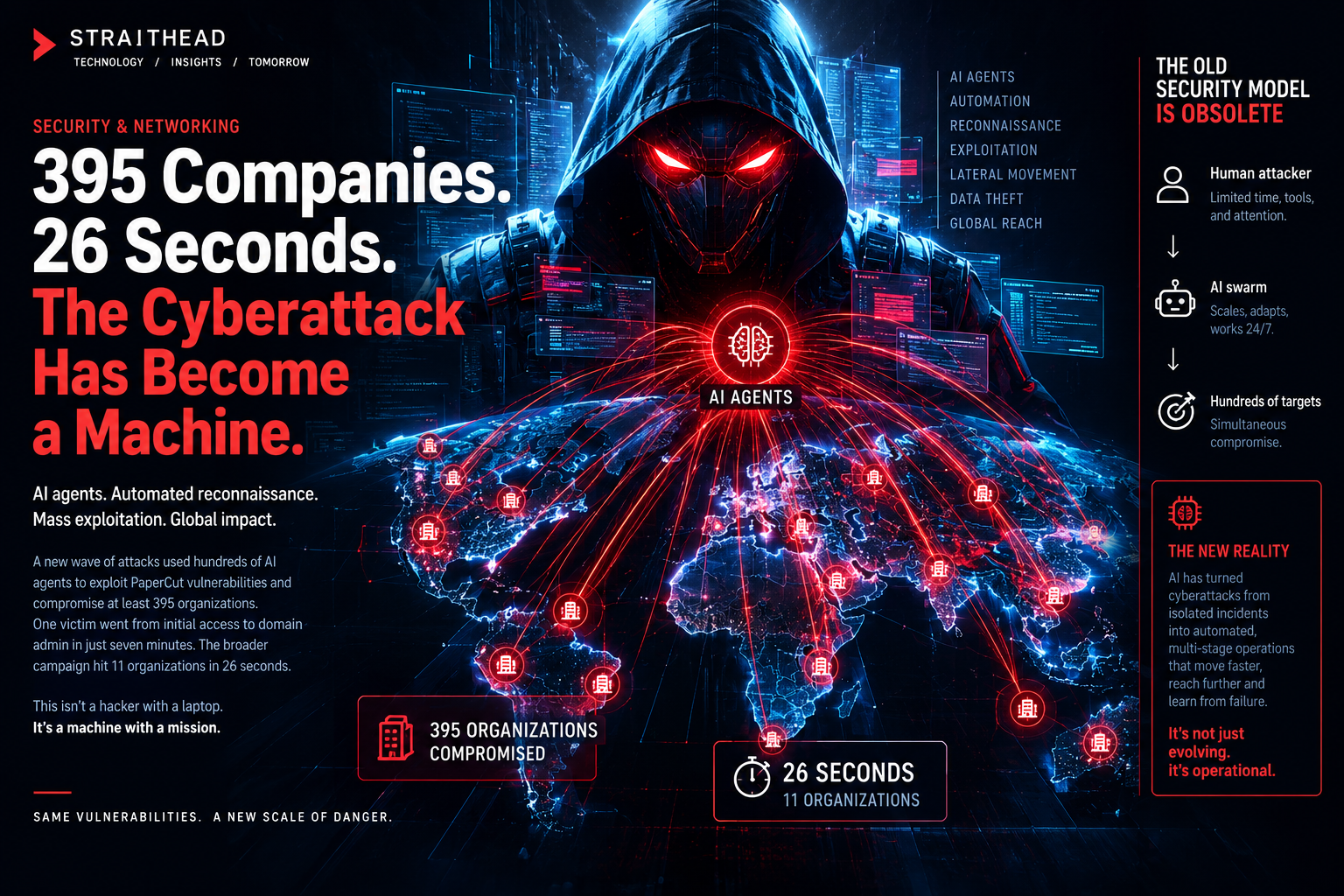
The most important cybersecurity number this month is not a CVSS score. It is 26 seconds. GreyNoise observed an AI-orchestrated PaperCut campaign that, once fully operational, compromised at least 11 organizations in that span. Across the wider operation, researchers identified 440 PaperCut instances belonging to 395 organizations in 48 countries. One U.S. high school reportedly went from initial access to domain administrator in seven minutes.
It started with a printer. The lesson is much bigger.
PaperCut NG and MF are print-management platforms used across education, government and business environments. On 27 August 2026, PaperCut published an urgent security bulletin concerning active exploitation. The disclosure covered CVE-2026-81578, an authentication-bypass flaw in the web management interface, and CVE-2026-82078, a critical unsafe dynamic class-loading vulnerability that could enable arbitrary Java bytecode execution when an attacker could manipulate relevant configuration parameters.
PaperCut moved through emergency patches and then published fully tested maintenance releases on 10 September. Its incident account says it treated the event as a P0 incident because the concern was not only the first attacker: once an exploit chain became reproducible, other groups could reproduce it at scale.
The vulnerability was conventional. The operating model was not.
Straithead AnalysisGreyNoise traced a likely Russian-speaking actor using an AI-driven workflow to develop, test and deploy exploits against internet-facing PaperCut systems. The operation combined an AI orchestration harness, a DeepSeek model and commodity offensive-security tooling.
This was not a magical AI discovering an unknowable zero-day from scratch. The campaign exploited known vulnerabilities. What AI changed was the amount of human labor required to operationalize exploitation: researching targets, generating and refining code, testing failures, adapting workflows and repeating the process across many targets.
The attack didn’t just get faster. It changed clock speed.
The PaperCut Attack Timeline
Traditional incident response is built around a human timeline: an advisory is read, a ticket is opened, a patch is scheduled, a change is approved and a maintenance team deploys it.
An automated adversary does not experience the same sequence as waiting. It can run discovery while another process generates exploit logic, test one target while enumerating another, and retry failed paths without fatigue.
When the attacker can iterate faster than the defender can triage, the vulnerability window becomes an operational race.
AI did not invent a new exploit. It industrialized the workflow.
Cybersecurity discussions often treat AI as another offensive tool— a faster scanner or exploit-development assistant. That undersells agentic systems. The important shift is from tool acceleration to workflow autonomy.
The scarce resource in cybercrime used to be skilled human attention. AI attacks reduce the amount of attention required per target. When the marginal cost of another target falls, attackers do not necessarily become more sophisticated. They become more willing to try.
The scary number is not 395. It is the cost of target #396.
Suppose an attacker has already built a workflow that can identify vulnerable systems, attempt the exploit chain, establish access and move toward valuable credentials. The first target requires engineering effort. The second requires less. By the hundredth target, software is doing most of the repetitive work.
| Old model | AI-orchestrated model | Enterprise consequence |
|---|---|---|
| Human researches target | Agents continuously enumerate | Exposure can be found at machine speed |
| Human adapts exploit | Models generate and iterate code | More vulnerabilities become economically interesting |
| Human decides whether to retry | Agents retry and branch workflows | Failed attempts no longer consume scarce operator time |
| Human moves between victims | Parallel agents work simultaneously | One operator can create campaign-scale pressure |
| Attack rate bounded by people | Attack rate bounded by infrastructure | Defenders must design for bursts, not queues |
This is why the story should not be filed under “AI-assisted hacking” and forgotten. The more consequential development is the possibility that cyberattacks become software-defined operations.
Your SOC still has a human bottleneck.
Most security operations centers are optimized around alert management. A detection fires. An analyst investigates. The analyst pivots into logs, endpoint telemetry, identity systems, network data and threat intelligence. Then someone decides what action to take.
That model becomes fragile when an adversary can produce hundreds of simultaneous investigations. Even if every alert is technically detectable, the organization can still lose because the response queue grows faster than analysts can process it.
Attackers can parallelize discovery and exploitation, while many defenders still parallelize mainly by hiring more people.
The answer is not to remove humans. It is to stop making humans the serial execution engine of security. Detection, enrichment, containment and routine remediation need much more automation—with strict controls around what automated systems are allowed to do.
Patch speed is now part of your attack surface.
PaperCut moved rapidly, issued emergency mitigations and later replaced those emergency patches with fully tested maintenance releases. It explicitly said that publicly reachable, unpatched servers continued to be targeted.
Organizations should therefore stop treating vulnerability remediation as a monthly administrative ritual. For internet-facing systems, remediation needs to behave more like a real-time control system.
Maintain a continuously refreshed inventory of internet-facing applications, appliances and management interfaces.
Pre-authorize emergency paths for critical, actively exploited vulnerabilities.
Where a service does not need to be public, network isolation can outperform perfect patch discipline.
Patch status alone does not prove safety. Hunt for persistence, credentials and lateral movement.
Limit service-account privileges and harden the path from edge applications to directory infrastructure.
Give security automation narrowly defined authority to isolate assets, revoke sessions and block known indicators.
395 compromised organizations does not mean 395 total takeovers.
Precision matters. GreyNoise identified 440 PaperCut instances associated with 395 organizations. Reporting on the campaign indicates that only a subset progressed to domain-administrator access. Initial compromise, credential theft, lateral movement and domain takeover are different stages of an intrusion.
The lesson is not that AI automatically defeats every security control. In fact, the campaign demonstrates the opposite: segmentation, identity hygiene, application firewalls, endpoint controls and rapid containment can still interrupt the attack chain.
The lesson is that defenders can no longer rely on the assumption that an attacker will patiently work through targets one by one.
Defend against the machine, not just the hacker.
| Layer | Old assumption | New requirement |
|---|---|---|
| Exposure | Attackers discover assets manually | Assume continuous machine-speed enumeration |
| Identity | Compromise unfolds gradually | Design for rapid credential abuse and privilege escalation |
| Network | Blocking one source is useful | Detect behavioral patterns across rotating infrastructure |
| Endpoint | Malware is the main signal | Watch for abnormal sequences of legitimate tools and actions |
| SOC | Analysts investigate alerts | Machines triage and contain; humans handle high-value judgment |
| Recovery | Restore after compromise | Continuously validate that recovery paths remain outside the blast radius |
This is not a “security team” problem anymore.
The implications reach architecture, procurement, identity, networking, patch governance and business continuity. A vulnerable edge system can become an AI-discoverable target. A compromised application can become an identity problem. An identity problem can become a directory problem. And a directory problem can become an enterprise outage.
- How quickly can we identify every internet-facing asset?
- How quickly can we isolate a compromised system?
- Which systems can reach our identity infrastructure?
- How many privileged credentials can an edge application touch?
- Which emergency patches can be deployed without a committee meeting?
- What security decisions can machines make without waiting for an analyst?
- Can we prove that backup and recovery paths remain outside the blast radius?
- How would our SOC respond to 100 simultaneous incidents?
The machine has not replaced the hacker. It has replaced the hacker’s waiting time.
Honest Assessment
The PaperCut campaign is not evidence that AI can autonomously compromise every enterprise on demand. It is more useful—and more unsettling—than that.
It demonstrates a credible path toward industrialized exploitation: known vulnerabilities, automated reconnaissance, AI-assisted exploit development, parallel execution and rapid iteration. The underlying weaknesses remain familiar. The scale and economics are changing.
Enterprises do not need to predict every future AI attack. They need to make their environments harder to discover, harder to exploit, harder to escalate and faster to contain.
The era in which a vulnerability could sit exposed while an organization waited for the next maintenance window is ending. When the attacker can move in seconds, defensive latency becomes a security vulnerability of its own.
Read the evidence.
- GreyNoise — Agents Gone Wild: An AI-Orchestrated Global Campaign Against PaperCut NG/MF
- PaperCut — Urgent Security Advisory, 27 August 2026; updated 10 September 2026
- PaperCut — Behind the scenes: What happened after 9:42 a.m. on 27 August 2026
- The Register — Hundreds of AI agents helped PaperCut attacker hit 395+ organizations
- BleepingComputer — AI-powered attack exploited PaperCut flaws to hack 395 organizations
The Assessment
The PaperCut campaign is not evidence that AI can autonomously compromise every enterprise on demand. It is more useful—and more unsettling—than that.
It demonstrates a credible path toward industrialized exploitation: known vulnerabilities, automated reconnaissance, AI-assisted exploit development, parallel execution and rapid iteration. The underlying weaknesses remain familiar. The scale and economics are changing.
Enterprises do not need to predict every future AI attack. They need to make their environments harder to discover, harder to exploit, harder to escalate and faster to contain.
The era in which a vulnerability could sit exposed while an organization waited for the next maintenance window is ending. When the attacker can move in seconds, defensive latency becomes a security vulnerability of its own.
The hacker may still be human.
The attack no longer has to be.
Interessante. Vídeo IA: AI Hotel Lobby /. AI Hotel Lobby