
Security & Networking
The Network Is No Longer the Perimeter.
5G, cloud-native telecom, edge computing and zero trust are dissolving the old security boundary. The enterprise is moving from defending a place to continuously authorizing identities, workloads, devices and resources.
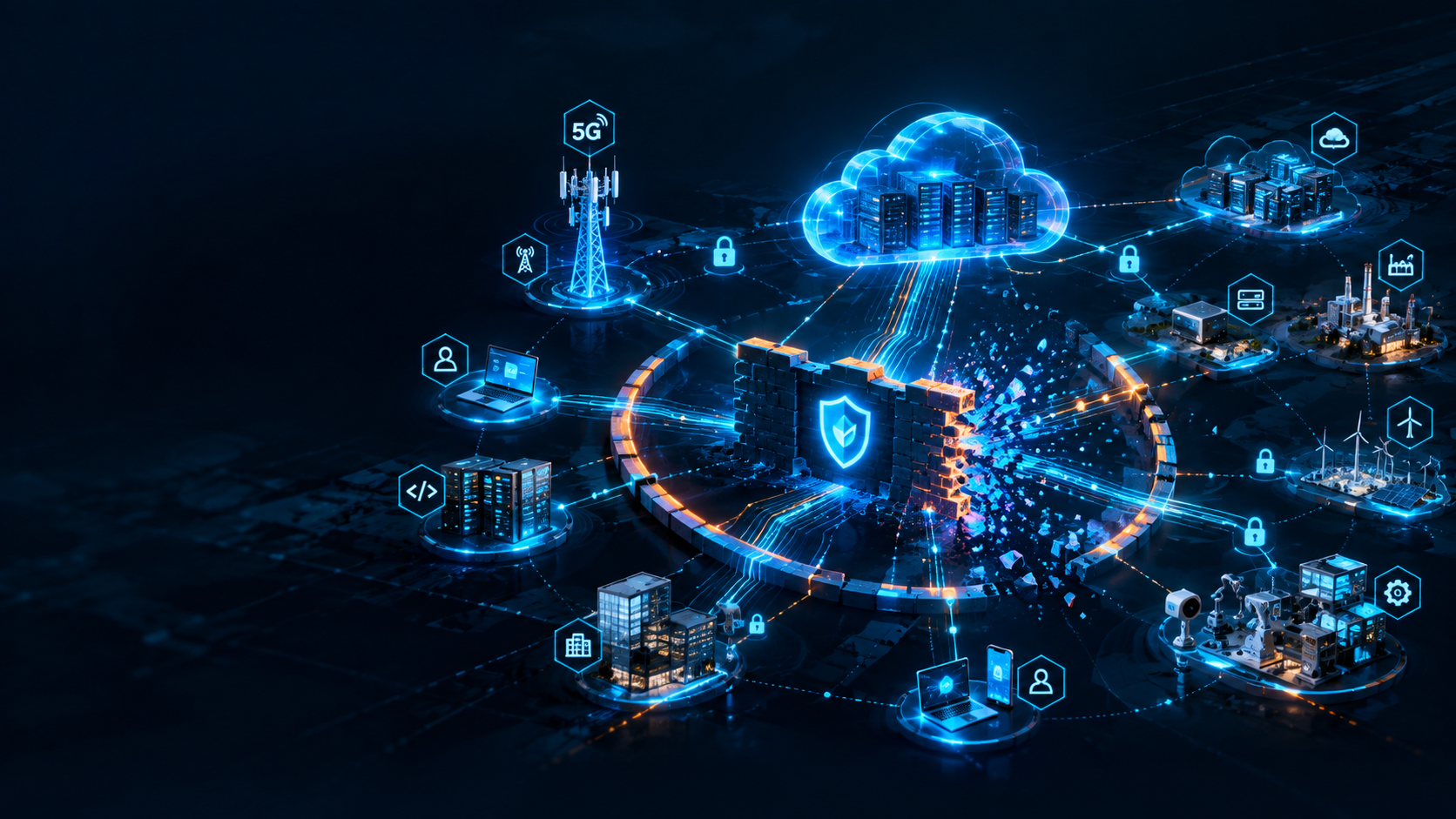
The network perimeter was one of enterprise IT’s most useful simplifications. Put trusted systems inside. Put hostile traffic outside. Build a firewall between the two. Then the world changed.
Employees stopped sitting in offices. Applications moved into SaaS and public clouds. Devices became mobile. Factories acquired connected machines. Edge computing pushed workloads outward. Telecom networks began adopting virtualization, open interfaces and cloud-native components.
The result is not simply a larger attack surface. It is a different definition of the word inside.
The strategic shift: the enterprise is no longer protecting a place called “the network.” It is protecting relationships between identities, devices, workloads, applications and resources that may never share the same network.
The Castle Model Worked Because the Enterprise Had an Inside
The classic enterprise architecture assumed that location carried meaning. A device connected to the corporate LAN was more trusted than one arriving from the internet. A server inside the data center was protected by segmentation. A remote user entered through a VPN and, once inside, inherited access to a broader network.
That architecture was never perfect, but it was operationally legible. Security teams could draw the boundary.
Now draw it again.
A user may be in a hotel. Their laptop may be managed by the enterprise. The application may run in a public cloud. Its database may sit in another cloud. Authentication may come from an identity provider. A transaction may pass through a telecom network. A device may connect over 5G. A service may call an API from a container that was deployed minutes ago.
Where, exactly, is the perimeter?
There may be several networks involved. There may be no single network that deserves to be called “trusted.”
Telecom Is Quietly Becoming Part of the Security Architecture
This is where the telecom story becomes more interesting than 5G speed.
Next-generation wireless networks are becoming software systems. NIST describes Open RAN as a disaggregated architecture in which network components use standardized interfaces and can run in virtualized, cloud-native environments. NIST is also researching zero-trust security for virtualized O-RAN functions and RAN intelligent controllers. citeturn0search1turn0search0
That matters because a traditional network appliance has a relatively clear security boundary. A distributed software-defined network has many more places where identity, configuration, code and policy matter.
The telecom network itself acquires a control plane, workloads, APIs, orchestration systems and software supply-chain dependencies.
And that means telecom security increasingly starts to resemble cloud security.
The New Perimeter Is Not a Firewall. It Is a Decision.
NIST’s zero-trust architecture explicitly moves security away from implicit trust based on network location and toward users, assets and resources. Its cloud-native model goes further, shifting policy from network parameters such as IP addresses and subnets toward application and service identities. citeturn0search2turn0search11
| Old perimeter logic | Emerging security logic |
|---|---|
| Is the request coming from inside? | Who or what is requesting access? |
| Is this subnet trusted? | Is this identity authorized for this resource? |
| Did the user authenticate once? | Does the current context still justify access? |
| Is the server behind the firewall? | What workload identity is communicating with it? |
| Can we isolate the network? | Can we contain the identity, workload or resource if compromised? |
This is more than a cybersecurity vocabulary change. It changes where security decisions live.
5G Adds More Boundaries—and More Control Points
NIST’s March 2026 5G security design guidance is revealing here. It treats 5G infrastructure as distinct traffic domains—data plane, control plane, and operations and maintenance traffic—and describes architectural principles for protecting them. citeturn0search4turn0search10
That is important because it shows the modern network is not one thing.
Each layer can carry security policy. Each layer can also become a place where policy is misconfigured, bypassed or compromised.
The security challenge therefore shifts from “secure the perimeter” to “make sure the entire chain agrees about who is allowed to do what.”
The Control Plane Is Becoming the Real Target
When infrastructure becomes programmable, the most valuable target may no longer be the packet path itself. It can be the system that tells the packet path what to do.
Who are the users, devices, workloads and services?
Who can change routing, segmentation, policy or network behavior?
Who can administer the infrastructure and its orchestration systems?
Does runtime traffic actually obey the intended policy?
This is one reason the telecom-to-cloud convergence matters. Once network functions run as software, the enterprise inherits many of the same security problems found in cloud platforms: privileged orchestration, workload identity, APIs, software supply chains, configuration drift and exposed management interfaces.
NIST’s March 2026 API-protection guidance reinforces the same point from another direction: cloud-native enterprise systems depend on APIs throughout development and runtime, making API lifecycle protection an enterprise security concern rather than merely an application concern. citeturn0search3
Edge Computing Breaks the Last Comfortable Assumption
The old data center gave security teams a physical center of gravity. Edge computing distributes it.
Factories, logistics sites, retail locations, vehicles, telecom sites and remote facilities can all become miniature compute environments. They may host workloads that matter operationally but do not live behind the same physical and network controls as the headquarters data center.
The network is still important. But it becomes one signal among several.
The Hardest Problem Is Now Machine Identity
Enterprises have spent years improving human identity. Modern infrastructure creates another problem at a much larger scale.
Devices have identities. Containers have identities. APIs have identities. Applications have identities. Service accounts have identities. Network functions have identities. Automated systems create and destroy workloads continuously.
If the security model depends on knowing which network a workload occupies, dynamic infrastructure will eventually defeat it.
The more useful question is whether the organization can establish a durable relationship between an identity, a purpose, a resource and a policy even when the underlying infrastructure moves.
That is the real zero-trust test: if a workload moves, a device changes networks, or a telecom function is redeployed, does the security policy move with the thing that needs protecting?
Open RAN Makes This More Than a Theory
Open RAN is a particularly useful case study because its promise and its security challenge come from the same architectural decision: disaggregation.
Multiple vendors, open interfaces and virtualized functions can increase flexibility and reduce dependence on a single appliance architecture. But they also introduce more interfaces, software components and integration points. NIST explicitly notes that moving to multi-vendor, disaggregated network functions in virtualized environments increases security challenges and requires stronger testing, threat modeling and supply-chain controls. citeturn0search13
And this is not merely a historical research question. On September 17, 2026, NIST published an initial public draft of a Cybersecurity Framework 2.0 profile specifically for federal O-RAN deployments. It calls for O-RAN deployments to be included in federal risk-management programs and maps O-RAN security specifications to CSF outcomes. citeturn0search16turn0search17
That is a useful signal: telecom security is moving from a specialized engineering concern toward an enterprise risk-management problem.
What Enterprises Should Stop Assuming
| Assumption | Better question |
|---|---|
| Inside the network means safer. | What evidence supports trust for this specific request? |
| VPN access is the security boundary. | What resources does the authenticated identity actually need? |
| Network segmentation solves lateral movement. | Can compromised identities and workloads be contained independently? |
| Telecom is just connectivity. | Which telecom control and management planes can influence enterprise access? |
| Cloud and telecom are separate security domains. | Where do network functions, APIs and workloads cross those boundaries? |
The Architecture Straithead Sees Emerging
The next enterprise network is not perimeterless. It is policy-defined.
Connectivity remains essential. Firewalls remain useful. Segmentation remains useful. VPNs, private networks, 5G security controls and network telemetry all still matter.
But none should be treated as the final trust decision.
That loop can operate across enterprise LANs, cloud environments, private 5G, public telecom networks and edge infrastructure.
It is also why the future of network security may be less about building a stronger wall and more about building a better decision system.
The Straithead View
The most important change in networking is not that 5G is faster or that Open RAN is more open.
It is that the network itself is becoming software.
Once connectivity becomes programmable, virtualized and distributed, the old boundary between network security, cloud security and application security becomes increasingly artificial.
The perimeter has not vanished. It has fragmented into thousands of smaller decisions made around identities, devices, workloads, APIs and resources.
The Assessment
Zero trust does not make networking simpler. It moves complexity from a relatively visible boundary into a much larger policy system.
That is both its strength and its danger.
If the organization has strong identity, reliable telemetry, explicit authorization and consistent enforcement, the loss of a single network perimeter can become manageable. If identity is fragmented, machine identities are poorly governed and control planes are weakly protected, the enterprise may simply replace one giant boundary with hundreds of invisible ones.
The telecom industry is now part of that transition. 5G, Open RAN, edge computing and cloud-native network functions are making the network more distributed and programmable. NIST’s current work on 5G, O-RAN and zero trust shows that security architecture is evolving alongside that transformation. citeturn0search1turn0search2turn0search16
The enterprise of the next decade will not ask where the network ends.
It will ask where the policy ends—and whether anything can cross that boundary without being explicitly authorized.
NIST — Zero Trust Networks
NIST SP 800-207A — Zero Trust Architecture for Cloud-Native Applications
NIST — Advanced Security Architectures for Next Generation Wireless
NIST — 5G Network Security Design Principles, March 2026
NIST — API Protection for Cloud-Native Systems, March 2026
NIST IR 8623 — Draft CSF 2.0 Profile for Federal O-RAN Deployment, September 2026
NIST — Open Radio Access Network