
Analytics & Digital Transformation
The Factory Is Becoming Software-Defined.
For a century, changing a factory meant changing hardware. The next manufacturing era is different: control, configuration and optimisation are moving into software — turning the production line into something that can increasingly be modelled, tested, deployed, versioned and observed.
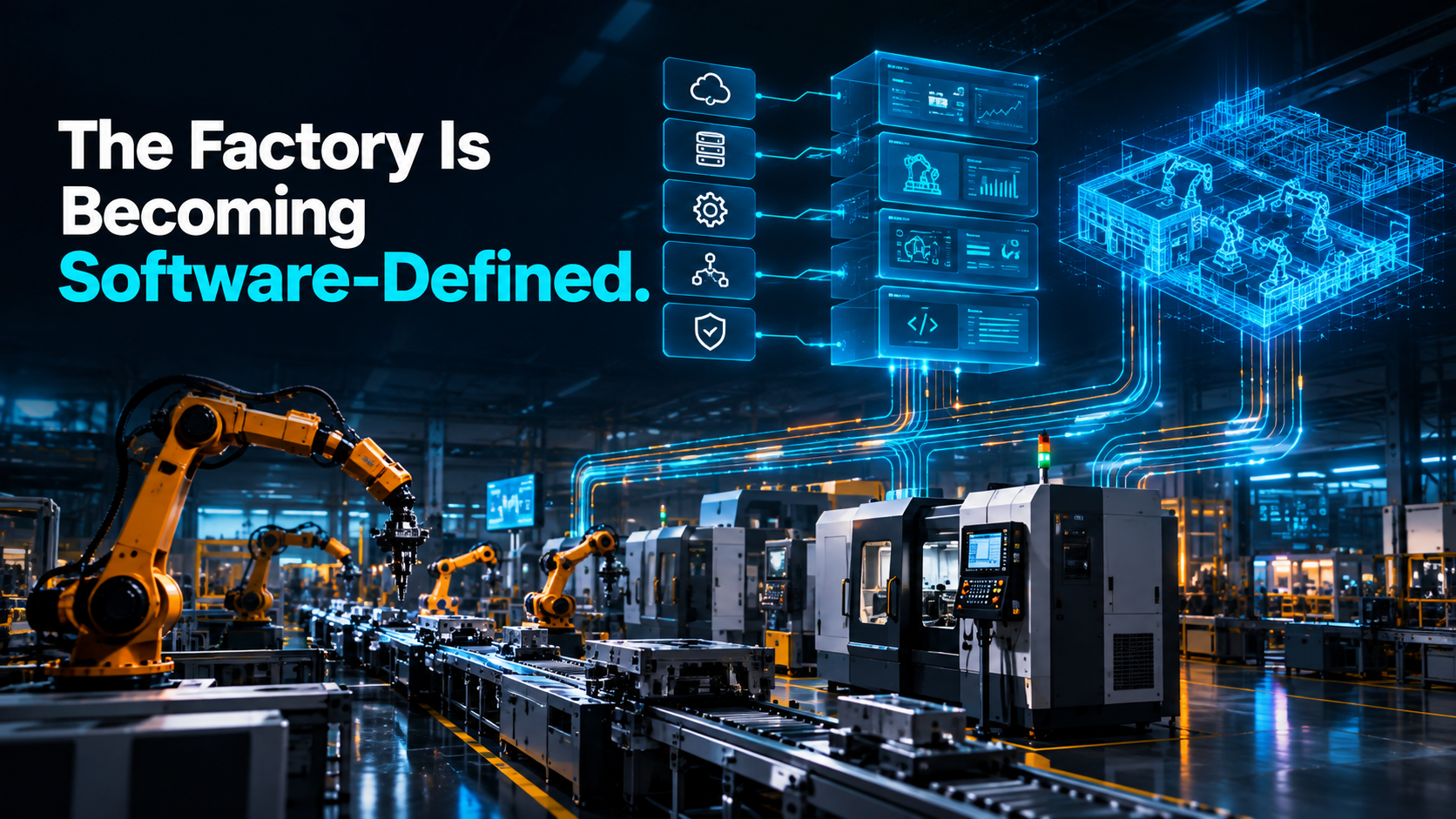
The next manufacturing revolution may not begin with a new robot. It may begin with a change in where the factory’s intelligence lives. For decades, production capability was tightly coupled to dedicated controllers, machines and vendor-specific hardware. That architecture produced reliability — but it also made change expensive. A new product variant, a new process or a new control function could mean new hardware, new engineering, commissioning and downtime. Software-defined automation is beginning to separate some of those functions from the physical equipment. The factory does not become software. Its ability to change increasingly does.
This is not the same thing as putting a factory in the cloud. Nor is a dashboard, an IoT gateway or a digital twin by itself a software-defined factory. The meaningful transition is architectural: standardised compute and connectivity, virtualised control runtimes, centrally managed applications, software-style engineering workflows and digital representations that can be used to test and validate changes before they reach production.
The competitive advantage is shifting from what machines a factory owns toward how safely and quickly that factory can change what those machines do.
From Hardware-Defined Production to a Software Control Plane
Traditional industrial automation deliberately binds control to equipment. A PLC, HMI, safety controller, drive system and machine are engineered as a tightly coupled system. That coupling is useful: deterministic behaviour, known interfaces and functional-safety engineering are not optional in an environment that moves heavy equipment around people.
But it also creates a structural cost. When the control layer is inseparable from the hardware layer, the factory’s upgrade path is constrained by the hardware lifecycle. A capability that is technically “just software” can become a physical engineering project because the software has nowhere standardised to run.
Software-defined automation attacks that coupling. Siemens describes three building blocks: a software infrastructure layer, virtualised runtimes for control/data applications, and IT-like engineering practices that increasingly resemble software development workflows.
Defines what should be produced and under which constraints.
Turns production intent into executable manufacturing workflows.
The layer where software-defined automation becomes materially different from ordinary factory IT.
Provides the execution environment between enterprise software and time-sensitive physical operations.
The physical process does not disappear. It remains the ultimate source of constraints and consequences.
That last point is critical. A software-defined factory is not a virtual factory. It is a cyber-physical architecture in which more of the control surface can be changed without physically replacing the thing being controlled.
The Moment the Controller Became Software
The clearest way to see the transition is the programmable logic controller itself. A conventional PLC is a physical industrial computer with tightly defined hardware and software. A virtual PLC moves that controller into a software runtime hosted on general-purpose infrastructure.
This is no longer theoretical. Siemens reports that Audi is using its SIMATIC S7-1500V virtual PLC in production at the Böllinger Höfe plant in Neckarsulm, with the controller deployed through Audi’s Edge Cloud 4 Production architecture. Siemens says the approach allows central management and software-based deployment of production functions; it also reports a failsafe virtual PLC certification for the platform.
Dedicated controller
Control capability is physically packaged with the automation hardware.
Software runtime
Control becomes an application that can run on a managed industrial compute layer.
Deployable factory function
New functions can be introduced through software without making every change a new hardware project.
Virtualisation does not mean removing physical safety engineering or deterministic requirements. The interesting engineering problem is precisely how software mechanisms can be introduced while preserving the guarantees expected from industrial control.
The Factory Is Starting to Acquire a Software Lifecycle
Once automation functions become software, an uncomfortable comparison appears. Software engineers expect versioning, test environments, controlled deployment, observability and rollback. Industrial engineers traditionally work through configuration management, commissioning, validation and change control.
The two disciplines are beginning to converge. Siemens explicitly describes the third building block of software-defined automation as IT-like engineering, including DevOps-style practices for industrial automation.
The important word is validate. A factory cannot simply inherit the software industry’s casual attitude toward production deployment. A bad web release can take down a service. A bad industrial release can damage equipment, stop a production line or create a safety event.
The factory’s deployment pipeline is becoming part of the production system.
The Factory Needs a Test Environment for Physical Change
This is where digital twins become strategically important. NIST defines manufacturing digital twins as synchronised virtual representations that can support observation, diagnosis, prediction and optimisation. Its current programme emphasises that useful twins need reliable data, validation and standards — not merely impressive visualisations.
NIST’s July 2026 workshop report is unusually revealing. It identifies four persistent barriers to scalable manufacturing digital twins: interoperability; verification, validation and uncertainty quantification; cybersecurity; and workforce readiness.
What exists physically?
Machines, processes, assets, states and relationships need a consistent digital representation.
Is the model still true?
A twin that drifts away from the physical system can become an attractive but dangerous source of false confidence.
Can the result be trusted?
NIST emphasises verification, validation and uncertainty quantification as part of establishing twin credibility.
What happens next?
The value rises when the twin informs a production decision, not when it merely renders a prettier factory.
A digital model describes. A digital shadow reflects. A more operational digital twin can support decisions and, in some architectures, influence the physical system. The closer the loop gets to control, the higher the burden of validation and trust.
The Hard Part Is Not Creating Another Digital Twin. It Is Making Twins Talk.
Factories are not greenfield software projects. They contain equipment from different decades, vendors, engineering disciplines and acquisitions. Each system may expose different protocols, identifiers, data structures and assumptions about what a signal means.
That is why the 2026 additions to ISO 23247 matter. ISO 23247-5 defines a digital thread for connecting and maintaining manufacturing digital twins across design, planning, production and testing. ISO 23247-6 addresses composition and interoperation of multiple digital twins, including integrated, unified and federated approaches.
| Problem | Why it becomes harder in a software-defined factory | What mature architecture needs |
|---|---|---|
| Legacy equipment | Old machines remain productive but were not designed around modern software interfaces. | Edge integration, adapters, stable interfaces and lifecycle planning. |
| Semantic mismatch | Two systems may both report “temperature” while meaning different things, units or operating contexts. | Shared information models and governed semantics. |
| Multiple twins | Machine, line, process and enterprise twins can each hold partial truths. | Composition and interoperation rather than another isolated model. |
| Validation | Simulation results can look precise while still carrying model or data uncertainty. | Verification, validation and uncertainty quantification. |
The implication is bigger than digital twins. The software-defined factory will be limited by its ability to establish common meaning across machines, applications and lifecycle stages. The factory therefore needs something analogous to an API economy — but for physical processes.
When Software Controls Physics, the Deployment Pipeline Becomes an OT Asset
Industrial cybersecurity has traditionally been framed around protecting controllers, networks, engineering workstations and plant equipment. Software-defined architecture adds another critical surface: the systems that build, distribute, authenticate and deploy the software that controls those systems.
NIST’s security work on digital twins points to cybersecurity and trust considerations created by digital representations, real-time monitoring and potential interaction with physical systems.
Traditional OT security asks: “Can an attacker reach the machine?”
Software-defined manufacturing adds: “Can an attacker make an authorised machine execute an unauthorised state?”
The Real Prize Is Not Lower Hardware Spend. It Is Lower Change Friction.
It would be easy to overstate the economic case. Software does not eliminate physical capacity. Robots still need to be purchased. Motors still fail. Tooling still wears out. Production cells still need safety validation. A virtual PLC does not turn a CNC machine into a general-purpose computer.
The more defensible proposition is narrower: software can move some kinds of industrial change from the capital-equipment lifecycle into the software lifecycle. Siemens’ Audi example describes exactly this direction: virtualised automation can reduce dependence on new hardware for certain changes, while centralised management can simplify deployment and maintenance.
| Factory change | Hardware-centric pattern | Software-defined direction |
|---|---|---|
| New function | New controller/device may be required | Deploy software where existing compute and interfaces permit |
| Engineering | Configuration tied to equipment | More reusable software components and IT-like workflows |
| Testing | Physical commissioning carries more of the burden | More simulation and virtual validation before physical deployment |
| Maintenance | Distributed device-by-device updates | Central management and controlled software lifecycle |
| Scaling | Replicate hardware configurations | Replicate validated software and infrastructure patterns |
The important shift is not that hardware disappears. It is that some adaptation costs can move from buying and installing equipment toward engineering, validation and software operations.
Faster deployment is valuable only when the factory can prove that the deployed change behaves safely and correctly in the physical world.
The Factory of 2030 Will Still Contain Machines from 2005
The software-defined factory is being built on top of an industrial installed base that cannot simply be replaced. A brownfield plant may contain multiple PLC generations, proprietary fieldbuses, old drives, vendor-specific HMIs, specialised machines and systems with long certification or maintenance cycles.
Keep the productive asset
Replacing functioning machinery merely to obtain a newer interface can destroy economic value.
Build the translation layer
Industrial edge infrastructure can connect older physical assets to newer applications without pretending the legacy system is modern.
Standardise meaning
Protocols move data. Shared information models help systems understand what that data means.
Plan the exit
Every adapter should have a lifecycle strategy so today’s bridge does not become tomorrow’s permanent silo.
The Factory Is Acquiring a Software Engineering Discipline
This transition does not mean replacing controls engineers with programmers. It means the boundary between the disciplines becomes a critical organisational interface.
Industrial software engineers
People who understand deterministic control, automation engineering and modern software lifecycle practices.
Model credibility
Engineers who can decide whether a digital model is sufficiently accurate for a particular production decision.
Cyber-physical security
Security teams that understand identity and software supply chains as well as physical consequences.
Industrial semantics
Experts who understand what production data means, not simply how to move it between systems.
The scarce skill will not be “software” or “manufacturing.” It will be the ability to reason across the boundary between them.
Six Moves That Matter More Than Buying Another Dashboard
Inventory the control plane
Map where control logic, configuration, recipes, software packages and deployment authority actually live.
Separate data from equipment
Create stable interfaces to machine data so every new application does not become a new vendor-specific integration.
Start with virtual commissioning
Use simulation where it can reduce commissioning risk and identify process problems before physical downtime.
Version important configurations
Treat production logic and critical configuration as controlled assets with provenance, approvals, testing and rollback.
Design for interoperability
Prefer documented interfaces, shared semantics and standards over integrations that create another closed island.
Protect the deployment path
Secure identities, build systems, packages, remote management and every mechanism capable of changing production behaviour.
The Factory Is Not Becoming a Computer. It Is Becoming Programmable.
That distinction matters. Computers are designed around software. Factories are constrained by physics, safety, materials, certification, energy, maintenance and people.
The software-defined factory therefore should not be judged by how much of the plant has been virtualised. It should be judged by a harder metric:
How much of the factory can change through software — and how confidently can the organisation prove that the physical result will remain safe, valid and economically useful?
That is why the developments around virtual PLCs, digital twins, industrial edge, IT/OT convergence and manufacturing standards matter together. They are not five unrelated technology trends. They are pieces of an emerging architecture for making physical production more configurable.
NIST’s current digital-twin work describes a systems-of-systems and lifecycle approach, while the newest ISO 23247 work is formalising digital threads and the composition of multiple twins. The standards work is a signal that the industry is moving from isolated digitalisation projects toward interoperable manufacturing systems.
The Assessment
The software-defined factory is real, but the transformation is not a software upgrade.
The hardest problems are not glamorous: legacy equipment, interoperability, semantic consistency, validation, safety, cybersecurity, organisational ownership and the credibility of digital models. A factory cannot adopt cloud-style deployment practices without adapting them to physical risk.
But the direction is increasingly visible. Audi is already operating virtualised control in production. Siemens is building an industrial stack around virtualised runtimes and IT-like engineering. NIST is treating digital-twin credibility and interoperability as standards problems. ISO is extending its manufacturing digital-twin framework into digital threads and twin composition.
The factory of the future may not be defined by having the newest machines. It may be defined by how quickly, safely and repeatedly it can change what its existing machines do.
Sources & References
- NIST — Digital Twins Workshops Summary Report, NISTIR 8620, July 2026. NIST
- NIST — Digital Twins for Advanced Manufacturing. NIST
- NIST — Security and Trust Considerations for Digital Twin Technology, NISTIR 8356. NIST CSRC
- NIST — Data Requirements for a Digital Twin of a CNC Machine Tool, January 2026. NIST
- ISO 23247-2:2021 — Digital twin framework for manufacturing, reference architecture. ISO
- ISO 23247-5:2026 — Digital thread for digital twin. ISO
- ISO 23247-6:2026 — Digital twin composition and interoperation. ISO
- ISO/TR 23247-101:2026 — Robotic welding digital-twin use case. ISO
- Siemens — The twin goals of production: efficiency and flexibility, January 2026. Siemens Blog
- Siemens — How AUDI switched to a virtual PLC, April 2026. Siemens Blog
- Siemens — SIMATIC S7-1500V Virtual PLC. Siemens
- World Economic Forum — Software-defined automation: the force awakens, February 2026. World Economic Forum
Editorial note: This article separates documented industrial deployments and standards from Straithead’s architectural interpretation. “Factory DevOps” and the five-layer stack are editorial frameworks used to explain the convergence; they are not presented as formal ISO definitions.