
Finland Gives Students a Real Quantum Computer — AaltoQ20 and the Future of Quantum Talent
Instead of simulators and remote cloud access, Aalto University installed its own 20-qubit quantum computer — and gave students direct access to it as part of their degree. A professor described this as rare even by global standards. Here is why it matters.AaltoQ20 Source: IQM / BusinessWire, Mar 2026
global quantum cluster Source: ECIPE Occasional Paper, Dec 2025
Finland needs by 2035 Source: InstituteQ Finland, 2025
value projected 2035 Source: McKinsey Global Institute, 2024
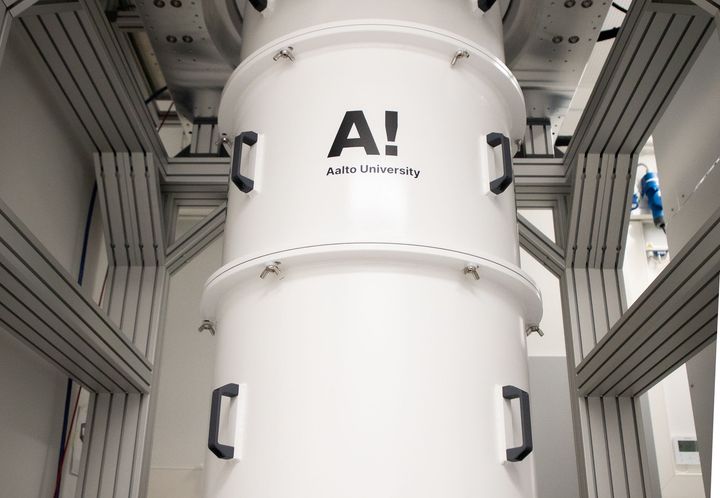 The AaltoQ20 quantum computer, installed at Aalto University, Espoo, Finland. The machine’s 20 superconducting qubits are housed inside the cylindrical cryogenic structure, which operates at temperatures close to absolute zero.
Photo: Matti Ahlgren / Aalto University · Source: Aalto University press release, March 11 2026
The AaltoQ20 quantum computer, installed at Aalto University, Espoo, Finland. The machine’s 20 superconducting qubits are housed inside the cylindrical cryogenic structure, which operates at temperatures close to absolute zero.
Photo: Matti Ahlgren / Aalto University · Source: Aalto University press release, March 11 2026
The system, called AaltoQ20, is a 20-qubit quantum computer designed for both research and education. Built in collaboration with Finnish quantum hardware company IQM Quantum Computers, it represents a deliberate investment in developing real-world quantum computing expertise from the ground up. For students studying quantum technologies, this means learning not just the theory — but working directly with real hardware.
The Problem with Simulation
Why the AaltoQ20 Quantum Computer Goes Beyond Simulators
Most universities today teach quantum computing through simulators or through shared cloud access to quantum processors operated by major technology companies. IBM Quantum, Google’s quantum services, and Amazon Braket have made quantum access more accessible than ever before. But these platforms, valuable as they are, carry a fundamental limitation.
Remote access means students interact with a black box. They submit circuits, receive results, and observe outputs — but they do not engage with how the system behaves in a real experimental environment. The noise characteristics of physical qubits, the engineering constraints of cryogenic systems, the practical challenges of quantum error mitigation: these are invisible from behind a cloud interface.
With AaltoQ20 installed locally, researchers and students gain direct proximity to the hardware and its experimental environment. This creates opportunities to explore quantum algorithms, study hardware behaviour, and confront real-world engineering challenges that simply cannot be replicated in simulation.
The difference between simulating a quantum computer and operating one is the same as the difference between simulating a flight and flying an aircraft. The physics only reveals itself fully when the system is real. Noise, decoherence, calibration drift, and gate fidelity are not abstract concepts — they are engineering problems that shape every result.
Professor Ala-Nissilä draws a pointed distinction between AaltoQ20 and the other university-owned quantum computers that exist in Europe. Most, he notes, have been largely experimental — built primarily to accumulate experience in construction. AaltoQ20 is different: it was built expressly to perform quantum calculations. That is not a semantic distinction — it determines the quality of research output the machine can support from day one.
“When institutions like Aalto University own their quantum computers, it means their data, their IP, and their expertise stay theirs. That’s not a feature — that’s a strategic posture to enable world-class research and education.”
— Jan Goetz, CEO and Co-founder, IQM Quantum Computers · Source: IQM / BusinessWire, March 11 2026
National Strategy
Building a National Quantum Ecosystem
AaltoQ20 is not an isolated academic project. It reflects a broader national strategy that Finland has been developing over the past decade — investing systematically across the full quantum stack, from hardware engineering and quantum algorithms to software infrastructure and workforce development.
Owning and operating a quantum system locally also creates advantages that extend beyond education. Universities can experiment more freely, manage research data internally, pursue novel hardware configurations, and explore new quantum applications without depending entirely on the commercial roadmaps of external providers.
This model repositions universities from passive consumers of quantum technology into active contributors to its development. That is a meaningful distinction — not just for research output, but for the type of expertise that gets built over time.
“The goal is not to produce quantum users. It is to produce quantum builders — engineers and researchers who understand the machines deeply enough to design what comes next.”
Historical Parallel
A Parallel From Finland’s Technology History
Those involved in the AaltoQ20 project have pointed to a compelling historical analogy that is worth taking seriously.
In the mid-twentieth century, Finnish researchers built their own analogue computers rather than relying entirely on imported systems. That engineering culture — hands-on, self-reliant, deeply practical — eventually contributed to a generation of technology innovators, and to the rise of companies such as Nokia. A similar philosophy is now being applied to quantum computing.
The parallel is not merely nostalgic. It points to a genuinely important insight about how technological leadership develops: it rarely comes from being an early adopter of another country’s technology. It comes from building the capability to design, operate, and improve the technology itself.
By training students on physical quantum systems from the earliest stages of their education, Finland is making a long-term bet that domestic hands-on expertise will compound over time into a genuine competitive advantage.
Workforce Development
Preparing the Quantum Workforce
The global demand for quantum specialists is growing faster than the supply. Governments, research institutions, and technology companies are all increasing investment in quantum computing research and development — but the pipeline of skilled engineers and researchers remains a bottleneck in almost every major economy. Finland, ranked the number two global quantum cluster and among the top five countries for quantum patent applications [ECIPE, Dec 2025 · PRH Finland, 2025], feels this constraint acutely.
The Finnish quantum industry is projected to require around 3,000 new skilled employees by 2035 [InstituteQ Finland, 2025] — the same year the global quantum market is estimated to reach a value of up to €90 billion [McKinsey Global Institute, 2024]. Finland needs to build that talent base from its own universities, and AaltoQ20 is a direct response to that projected gap. That is not a distant projection — the talent competition for quantum engineers is already active, with the United States, Germany, Canada, and China all running significant national quantum workforce programmes.
Direct exposure to quantum hardware is likely one of the most effective ways to build that talent pipeline. Students who have calibrated qubits, debugged quantum circuits on physical hardware, and worked through real decoherence problems are qualitatively different from those who have only run circuits through a cloud API.
The quantum workforce challenge is not primarily about theoretical knowledge — it is about practical engineering experience. AaltoQ20 is designed specifically to close that gap, giving students the kind of hands-on exposure that classroom instruction and remote simulators cannot replicate.
What Makes This Genuinely Unusual
Students Access the AaltoQ20 Quantum Computer As Part of Their Degree
This is the detail that sets AaltoQ20 apart from almost every other university quantum initiative globally — and it deserves to be stated plainly.
Students enrolled in Aalto’s Quantum Technology major will use AaltoQ20 as part of their standard degree programme. Not as an optional extra. Not reserved for PhD researchers. Not accessible only through a cloud interface managed by a commercial operator. As part of their studies, on a world-class quantum computer physically located on their campus.
Professor Ala-Nissilä, speaking at the launch, was unambiguous about how unusual this is: it is “rare even on a global scale.” That framing is significant coming from someone embedded in the European quantum research community. Most quantum programmes at universities worldwide are teaching students to use quantum computers built and operated by companies — IBM, Google, IonQ — via cloud interfaces, a model that mirrors the broader dependency questions we analysed in our piece on how open cloud platforms actually are. Aalto students will be running experiments on hardware their university owns.
“Q20 allows Aalto to have its own computer for researchers to easily access, and students in the Quantum Technology major will get to use it as part of their studies — which is rare even on a global scale.”
— Professor Tapio Ala-Nissilä, Department of Applied Physics, Aalto University
The Quantum Technology programme at Aalto is a full Bachelor of Science degree — 180 ECTS credits, taught entirely in English, with the Quantum Technology major comprising 65 credits of core study. [Aalto University academic catalogue, 2025–26] The curriculum covers quantum mechanics, quantum circuits and information, quantum algorithms, and experimental work on quantum systems. AaltoQ20 now sits at the centre of that experimental dimension.
Notably, the Quantum Technology minor — a lighter-touch introduction to the field — is open to all Aalto students, not just those in the specialist major. [Aalto University programme information, 2025] This means students across engineering, computer science, mathematics, and electrical engineering can gain exposure to quantum concepts, and potentially to the hardware itself, within their existing degrees.
Aalto and CSC researchers have already put the machine to work from day one — using it to study quantum computing algorithms and quantum machine learning. [Aalto University announcement, March 2026] This is not a system waiting to become useful. It is already producing research.
AaltoQ20 is accessible through three channels: directly by Aalto researchers and Quantum Technology students on campus; through FiQCI — the Finnish Quantum Computing Infrastructure jointly administered by VTT, Aalto, and CSC; and via LUMI, the EuroHPC pre-exascale supercomputer, which will extend access to researchers across the European Union. [IQM / CSC / Aalto joint announcement, March 2026] A Finnish student and an EU researcher in another country will both be able to run experiments on the same machine.
The AI Connection
Why This Matters for Artificial Intelligence
Quantum computing remains an emerging technology, and claims about its near-term impact on AI deserve careful scrutiny. But the longer-term intersection between quantum computing and artificial intelligence is a serious area of active research — as we explored in our analysis of why the future of AI may depend on quantum computing — and the AaltoQ20 initiative is relevant to it in ways that are worth making explicit.
The computational problems where quantum advantage is most credibly expected include several that are directly relevant to AI:
- Complex optimisation problems — relevant to logistics, resource allocation, and model architecture search
- Probabilistic modelling — quantum sampling algorithms may accelerate certain classes of generative models
- Large-scale scientific simulation — drug discovery, materials science, and molecular modelling where AI and quantum may combine
- Certain machine learning techniques — quantum kernel methods and variational quantum algorithms are active research areas
None of these intersections are immediate. The hardware limitations of current quantum systems — noise, limited qubit counts, short coherence times — mean that practical quantum advantage over classical AI is likely still years away at meaningful scale. But the researchers who will eventually navigate that transition are being trained now. Initiatives like AaltoQ20 are building that generation.
Broader Significance
What the AaltoQ20 Model Signals
Zooming out, the AaltoQ20 quantum computer reflects a broader shift in how quantum computing education is evolving globally. The early phase — teaching quantum theory, running cloud simulations, and monitoring vendor roadmaps from a distance — is giving way to something more substantive.
Universities are beginning to take ownership of quantum infrastructure. National strategies are moving from awareness-raising to genuine capability-building. And the distinction between countries that shape quantum development and those that adopt it is starting to form.
For students, the AaltoQ20 model means learning how quantum machines behave in real experimental environments — not just how they are supposed to behave in textbooks. For the global technology ecosystem, it means adding another node of genuine quantum expertise to a network that needs many more of them.
If quantum computing becomes a foundational technology in the coming decades — and the weight of institutional investment suggests that is the direction the field is heading — then initiatives like AaltoQ20 may prove to be important early chapters in a much longer story.
The countries that will lead in quantum computing are not necessarily those with the most investment. They are those with the most capable people.
AaltoQ20 is a 20-qubit machine at one university in Espoo. In isolation, that is a modest data point. In context — as one element of a coherent national strategy to build hands-on quantum expertise from the undergraduate level upward, in a country ranked the number two global quantum cluster — it is something considerably more significant.
The analogue computer engineers of mid-century Finland did not know they were building the foundation for Nokia. The undergraduate students who will run their first real quantum experiments on AaltoQ20 do not yet know what they will build. But the pattern is worth watching: deep, practical, hardware-level expertise — built at degree level, on machines owned by the institution, in a national ecosystem with a coherent strategy — compounds over time in ways that cloud access and simulation simply cannot replicate.
- IQM Quantum Computers / BusinessWire — AaltoQ20 launch press release, March 11 2026
- Aalto University — official programme announcements and AaltoQ20 research communications, March 2026
- Professor Tapio Ala-Nissilä, Aalto University — quoted in Aalto University press materials, March 2026
- Jan Goetz, CEO IQM Quantum Computers — quoted in IQM / BusinessWire press release, March 11 2026
- InstituteQ Finland — Finnish quantum workforce projections: 3,000 jobs by 2035
- ECIPE Occasional Paper, December 2025 — Finland ranked #2 global quantum cluster
- Patent and Registration Office of Finland (PRH) — top five countries for quantum patent applications, 2025
- McKinsey Global Institute, 2024 — global quantum market value projection: €90B by 2035
- CSC — Finnish IT Centre for Science, FiQCI and LUMI integration documentation
- Main image: Matti Ahlgren / Aalto University — AaltoQ20 quantum computer, March 11 2026 (via STT Info / Aalto University press release)