
Enterprise AI
The Numbers Are Converging: What the AI Economy Will Look Like by 2030.
AI is getting cheaper to use. The machine required to deliver it is getting bigger. Across models, data centres, chips, networks and electricity, the numbers point to an economy in which intelligence becomes more accessible — while the infrastructure behind it becomes more capital-intensive, constrained and strategically important.
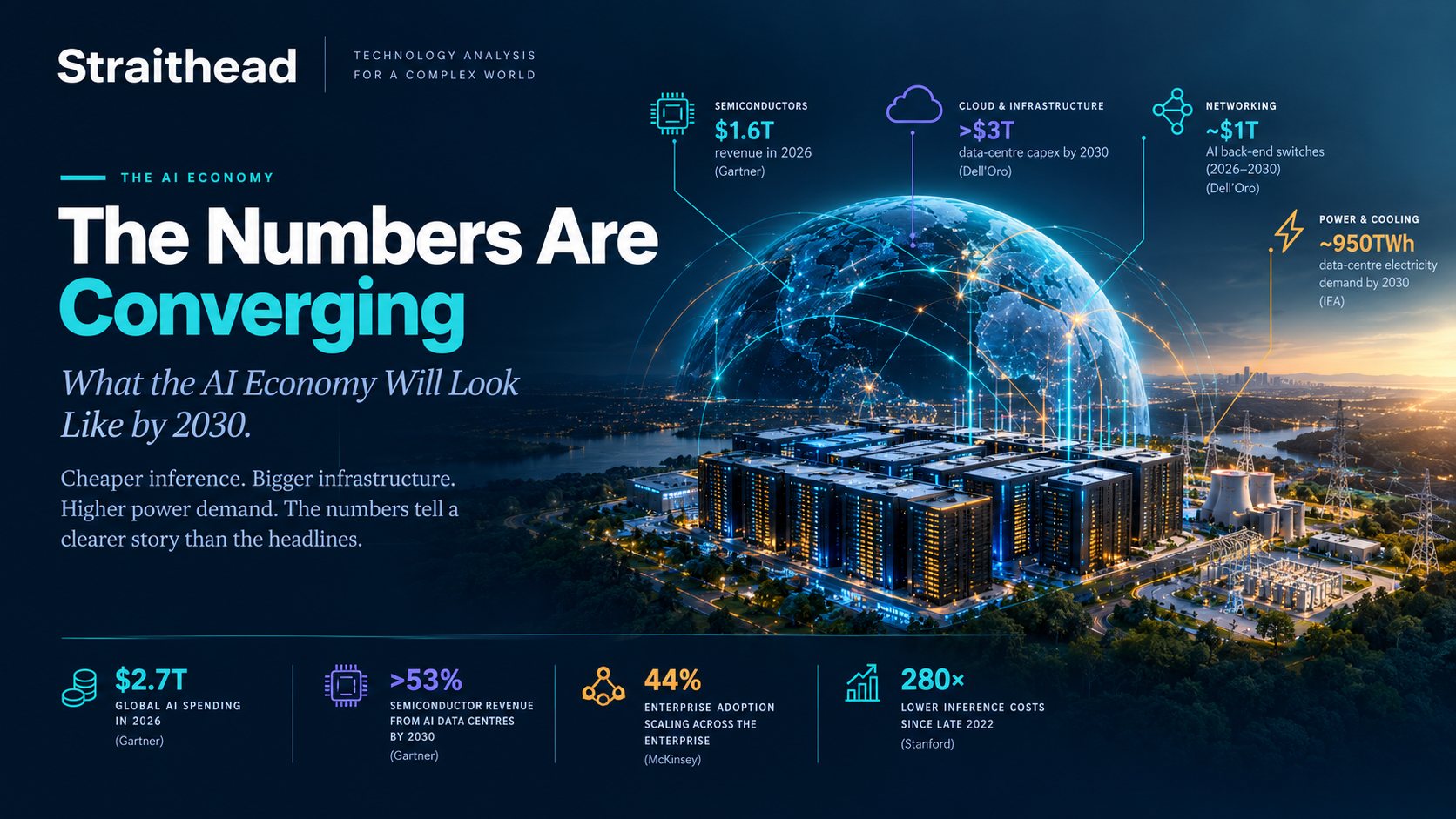
The AI economy is producing a strange combination: the cost of using a model can fall by orders of magnitude while the total capital committed to AI infrastructure keeps climbing. These trends are not contradictory. Cheaper intelligence encourages more use; more use creates demand for compute, memory, networking, power and cooling. The result is a market where the unit gets cheaper while the system around it gets larger. By 2030, the decisive AI question may be less “How smart is the model?” and more “Who can deliver useful intelligence reliably, economically and at scale?”
The numbers below come from forecasts and observed benchmarks published by Gartner, the International Energy Agency (IEA), Dell’Oro Group and Stanford’s AI Index. They measure different things and should not be added together: AI spending is a broad market estimate; data-centre capex is capital investment; electricity is physical consumption; inference prices are a benchmark for a particular level of model performance. Their value is in the direction they reveal when read together.
AI is becoming a commodity at the point of use and an infrastructure industry at the point of delivery. Falling model costs can expand demand, but the ability to turn that demand into useful output will depend on scarce capacity, efficient systems, distribution, power, and a credible path to returns.
AI Is Getting Cheaper. The AI System Is Getting More Expensive.
Stanford’s 2025 AI Index documented a dramatic decline in the price of querying a model that scored at roughly GPT-3.5 level on a particular benchmark: from $20 per million tokens in November 2022 to $0.07 by October 2024. That is a reduction of more than 280 times. It is not a universal price index for all AI tasks, and it does not mean every workload is 280 times cheaper. It does show how quickly comparable capability can become less expensive to access.
Meanwhile, Gartner forecast global AI spending of $2.7 trillion in 2026, 49.5% above 2025. Gartner’s category includes infrastructure, services, software and other AI-related spending; it is not a measure of revenue captured by model vendors alone. The infrastructure category is the largest component in its forecast, reflecting the cost of building capacity ahead of anticipated workloads.
Cost per unit can fall
Better hardware, smaller and more capable models, inference optimisation, competition and open-weight alternatives can reduce the price of a given capability.
Total demand can rise
Lower prices make more use cases viable. More requests, longer context, multimodal workloads and multi-step agents can increase total compute consumed.
This is the first convergence: the falling price of a unit of intelligence does not automatically shrink the market. If usage expands faster than unit costs decline, total spending can rise. That is a plausible pattern for AI, but it is not a law of nature. If useful demand, willingness to pay or enterprise returns disappoint, spending can slow even while model prices continue to fall.
The Infrastructure Forecast Is Now Measured in Trillions
In August 2026, Dell’Oro Group forecast that worldwide data-centre capital expenditure would surpass $3 trillion by 2030. The firm said its outlook had nearly doubled since its January forecast, reflecting higher hyperscaler investment guidance, greater projected power capacity and higher commodity costs. High-end accelerators are expected to account for the largest share of capex growth.
That number is a forecast, not money already spent and not a guarantee that every announced project will be built. The forecast itself makes the risk visible: Dell’Oro points to power availability, supply chains and the sustainability of investment as conditions that could change the trajectory. The four largest US hyperscalers could account for about half of global data-centre capex, according to the firm’s outlook.
The flow matters because a data centre is not a pile of GPUs. Accelerators need high-bandwidth memory, fast interconnects, storage, power conversion, cooling, facilities, network capacity and software that keeps expensive hardware busy. A bottleneck in one layer can constrain the return on investment in all the others.
The $3 trillion figure is a forecast for data-centre capital expenditure, not $3 trillion of AI revenue, not the value of AI companies, and not a guaranteed return. Capital deployment and value creation are related — but they are not the same measure.
AI Is Becoming a Physical Infrastructure Problem
The IEA’s April 2026 update projects global data-centre electricity consumption to rise from about 485 terawatt-hours in 2025 to around 950 TWh in 2030 — roughly double, and approximately 3% of global electricity demand by the end of the decade. Electricity use from AI-focused data centres is projected to grow faster still, tripling over the period.
Electricity is only one part of the constraint. New capacity also needs grid connections, substations, transformers, power electronics, cooling, land, fibre, construction capacity and permits. These systems do not scale at the speed of a software release. The IEA highlights bottlenecks across energy equipment and chip manufacturing, and notes that projects can be delayed by local constraints and the economics of financing.
Generation is not delivery
A country can have enough electricity in aggregate while a specific region lacks grid capacity or a timely connection for a large new load.
The long-lead components
Transformers, switchgear, power conversion and cooling systems become strategic inputs when data-centre buildouts accelerate together.
Location becomes a capability
Access to power, fibre, land, water where needed, and regulatory permission can influence where AI capacity is built and how quickly it can come online.
Efficiency becomes economic
Model routing, workload scheduling, hardware utilisation and cooling efficiency affect how much useful work a site can deliver per unit of scarce capacity.
This does not mean AI will inevitably run out of electricity. The IEA’s outlook is a central scenario, not a fixed ceiling. Supply, efficiency, siting, grid investment and demand response can all change the result. The more defensible conclusion is that energy infrastructure will increasingly shape the speed, cost and geography of AI expansion.
The Economic Centre of Gravity Moves from Training to Use
Training frontier models attracts attention because it is concentrated, expensive and technically dramatic. But training is only the beginning of a model’s commercial life. Once deployed, a model may answer questions, classify documents, generate code, interpret images, call tools, operate agents and support millions of recurring workflows.
The IEA notes that new energy-intensive applications — including reasoning, video generation and agentic tasks — can consume hundreds or thousands of times more energy per query than simple text generation. That comparison is highly workload-dependent; it is not a universal ratio for every agent or video request. Its significance is that “one AI query” is becoming an increasingly poor unit for measuring cost or infrastructure demand.
As systems become more agentic, costs can move from the price of a single response to the cost of completing a whole task. A workflow may invoke multiple models, retrieve data, call tools, check results and repeat steps. Better orchestration and smaller-model routing can reduce the bill; poor design can multiply it. The useful metric is therefore not simply tokens per dollar. It is cost per successful, valuable outcome.
Cheap Intelligence Does Not Mean Cheap AI Infrastructure
If model capability becomes more interchangeable, some value may migrate toward the layers that are difficult to reproduce: efficient compute, memory, networking, power, cloud distribution, proprietary data, workflow integration, security, and trusted access to customers. This is not a prediction that model providers will lose all pricing power. Differentiated capability, reliability, latency, privacy and distribution can still support strong economics.
| Layer | Potential source of value | What could weaken it |
|---|---|---|
| Models | Capability, reliability, latency, multimodality and developer ecosystem | Open alternatives, model convergence, price competition and switching |
| Compute and memory | Performance, supply, utilisation and energy efficiency | New architectures, excess capacity, supply normalisation and faster obsolescence |
| Cloud and inference | Distribution, scale, orchestration, security and operational simplicity | Customer multi-cloud strategies, price pressure and workload migration |
| Data and workflow | Context, integration, permissions and proximity to business decisions | Poor data quality, weak adoption and limited measurable business impact |
| Applications | Owning a valuable process and delivering an outcome customers pay for | Commoditised features, easy replication and unclear return on investment |
| Energy and facilities | Available capacity, location, reliability and speed to deployment | Grid delays, cost overruns, policy changes and underutilised sites |
The strategic implication is not “buy infrastructure” or “avoid models.” It is to identify which layer your organisation can differentiate in, which layers it should rent, and which dependencies could become expensive or difficult to change. The answer will vary by company, workload and geography.
The Market Can Grow While Some Investments Lose Money
A fast-growing market does not guarantee attractive returns for every participant. Infrastructure spending happens upfront; revenue and productivity gains arrive later, if they arrive. A facility can be built before demand is contracted. Hardware can depreciate faster than expected. A model can become cheaper before its owner recovers training and deployment costs. An enterprise can roll out copilots without changing the workflow enough to capture measurable value.
Gartner’s September 2026 forecast points to $2.7 trillion in worldwide AI spending that year and a $1.2 trillion AI-services opportunity by 2030. These are broad market estimates. They should not be interpreted as evidence that every AI infrastructure project will earn an adequate return.
The other side of the investment picture is risk. In an October 14, 2026 warning, Gartner said more than $3.5 trillion of AI infrastructure spending could be exposed to impairment by the end of 2030 if providers maintain their current pace of capital spending. That is a conditional risk estimate, not a prediction that $3.5 trillion will certainly be lost. It highlights the gap between announced capital plans and the revenue required to support them.
Can the infrastructure earn enough over its useful life to cover operating costs, financing, depreciation and the return demanded by investors? The answer depends on utilisation and monetisation — not on how impressive the capacity looks in a press release.
This is where the AI economy could bifurcate. Efficient operators with contracted demand, high utilisation and strong distribution may prosper. Projects that depend on continuously rising valuations, optimistic utilisation or a single narrow workload may be more exposed. Both outcomes can coexist inside a rapidly expanding market.
The Enterprise AI Budget Will Be Judged by Outcomes, Not Tokens
McKinsey’s 2026 State of AI survey found that 44% of respondents said AI was scaling across their enterprise, up from 38% a year earlier. Nearly nine in ten reported regular AI use in at least one business function. These are survey findings, not a census of all companies; they indicate broadening adoption while leaving substantial variation in maturity and value capture.
As usage grows, the cost base can become less visible. An employee may see a simple assistant; finance sees subscriptions, inference, data preparation, integration, governance and support. An agent may reduce manual work but also add model calls, verification steps, human review and exception handling. Without measurement, lower token prices can mask rising total consumption.
Cost per completed task
Include model calls, retrieval, tools, retries, human review and failure handling — not just the first response.
Quality and risk
Track accuracy, escalation, data exposure, compliance and the cost of correcting an incorrect result.
Workflow impact
Measure cycle time, throughput, error rate and the actual change in work rather than the number of users with access.
Economic capture
Identify whether gains become lower costs, higher output, improved revenue, better service or reduced risk.
The organisations best positioned for 2030 will not necessarily be those that use the most AI. They will be those that connect AI usage to governed data, redesigned workflows, clear accountability and an auditable economic result.
AI Capacity Will Be Shaped by Where the Physical System Can Exist
Cloud computing made capacity feel geographically abstract. AI brings some of that geography back into view. Large training and inference clusters depend on power availability, high-speed connectivity, equipment supply, cooling, land, skilled operations and regulatory permission. Data residency, sovereignty and latency can further influence where workloads run.
This will not produce a simple map in which every country builds its own frontier-scale model infrastructure. Economies of scale still matter, and many organisations will consume AI through global cloud and software platforms. But more jurisdictions and enterprises will treat AI capacity as a strategic dependency — and will weigh local control, resilience and cost against the advantages of shared global infrastructure.
The result is likely to be a layered geography: large centralised clusters for some workloads; regional and sovereign facilities for others; edge and on-device inference where latency, privacy, connectivity or operating cost justify it. The optimal architecture will depend on the task, not on a universal rule that everything must be centralised or local.
What the Converging Numbers Actually Suggest
AI economics will be measured per outcome
As models and tokens become less useful as standalone cost measures, enterprises will increasingly evaluate cost, quality and risk per completed workflow or business result.
Infrastructure constraints will shape deployment
Power, memory, networking, grid connections and deployment lead times will influence where and how fast capacity can scale, even as software capability improves.
Returns will separate winners from overbuilders
If AI demand grows more slowly than announced capital plans, some projects and providers will face underutilisation or impairment. If monetisation catches up, much of that capacity may be absorbed. Both paths remain possible.
These are not precise forecasts of market share or company winners. They are conclusions bounded by the evidence: unit costs have fallen sharply, infrastructure investment forecasts have expanded, electricity demand is projected to rise, and enterprises are still working to translate adoption into measurable outcomes.
Five Curves, One Economic System
The most useful way to understand the AI economy is to track the curves together rather than treating each headline as a separate story.
The curves do not move at the same speed. Model efficiency can improve quickly. Grid upgrades and new power equipment take longer. Usage can accelerate before organisations redesign workflows. Capital can arrive ahead of reliable demand — or lag behind it. The economic result depends on the interaction between these time scales.
That is the core convergence: AI is both a software capability and an industrial system. Treating it as only one of those things leads to distorted decisions. A model-only view misses the physical constraints. An infrastructure-only view misses the demand response that cheaper and more useful AI can unlock.
The AI Economy Will Be Built on Cheap Intelligence — and Expensive Reliability
By 2030, AI capabilities may be cheaper and more widely embedded across software, products and business processes. But delivering a useful result will still require infrastructure, trusted data, system integration, security, reliability and an organisation capable of changing how work gets done.
That means value will not accrue automatically to the layer with the most visible technical breakthrough. It will accrue where capability is converted into dependable service and measurable outcomes. For some companies, that will mean differentiated models. For others, it will mean cloud distribution, hardware efficiency, power capacity, specialised data or ownership of a high-value workflow.
For enterprise leaders, the practical response is to stop treating AI spending as a single budget line. Separate model consumption from infrastructure and integration. Test unit economics on real workloads. Understand capacity and vendor dependencies. Build portability where it matters. And fund deployment based on evidence of business impact, not on a forecast alone.
The Assessment
The numbers are converging, but they do not prove that every AI investment will pay off — or that the biggest forecasts will be realised exactly as published.
The evidence does support a more nuanced conclusion: model costs have fallen sharply; AI spending and data-centre investment forecasts are rising; electricity demand is projected to roughly double by 2030; and enterprise adoption is broadening while organisations continue to work toward measurable returns.
The key uncertainty is not whether AI will matter. It is how quickly useful demand, monetisation and productivity gains can catch up with the capital and physical infrastructure being committed today. Efficiency could make AI far more accessible. It could also increase total demand faster than it reduces the system’s cost. Both effects can be true at once.
By 2030, the strongest AI businesses may not simply be the ones with the smartest models. They may be the ones that turn cheaper intelligence into reliable outcomes — without losing control of the infrastructure, economics or energy required to deliver them.
Sources & References
- Gartner — “Gartner Forecasts Worldwide AI Spending to Grow 49.5% in 2026,” September 16, 2026. Gartner
- Dell’Oro Group — “AI Buildout Maintains Momentum as Data Center Capex Surpasses $3 Trillion by 2030,” August 18, 2026. Dell’Oro Group
- International Energy Agency — Key Questions on Energy and AI, April 16, 2026. IEA
- Stanford Institute for Human-Centered AI — 2025 AI Index Report: Research and Development. Stanford HAI
- McKinsey & Company — “The State of AI in 2026: On the Road to ROI,” August 25, 2026. McKinsey
- Gartner — “Over $3.5 Trillion of AI Infrastructure Spending Could Be Exposed to Impairment by the End of 2030,” October 14, 2026. Gartner
Editorial note: Spending and capex figures are forecasts from the named organisations, not observed future outcomes. Electricity projections are scenario-based. Inference-cost comparisons refer to a specific performance benchmark and period, not every model or workload. Straithead’s 2030 predictions are analytical interpretations of these sources, not quoted forecasts.